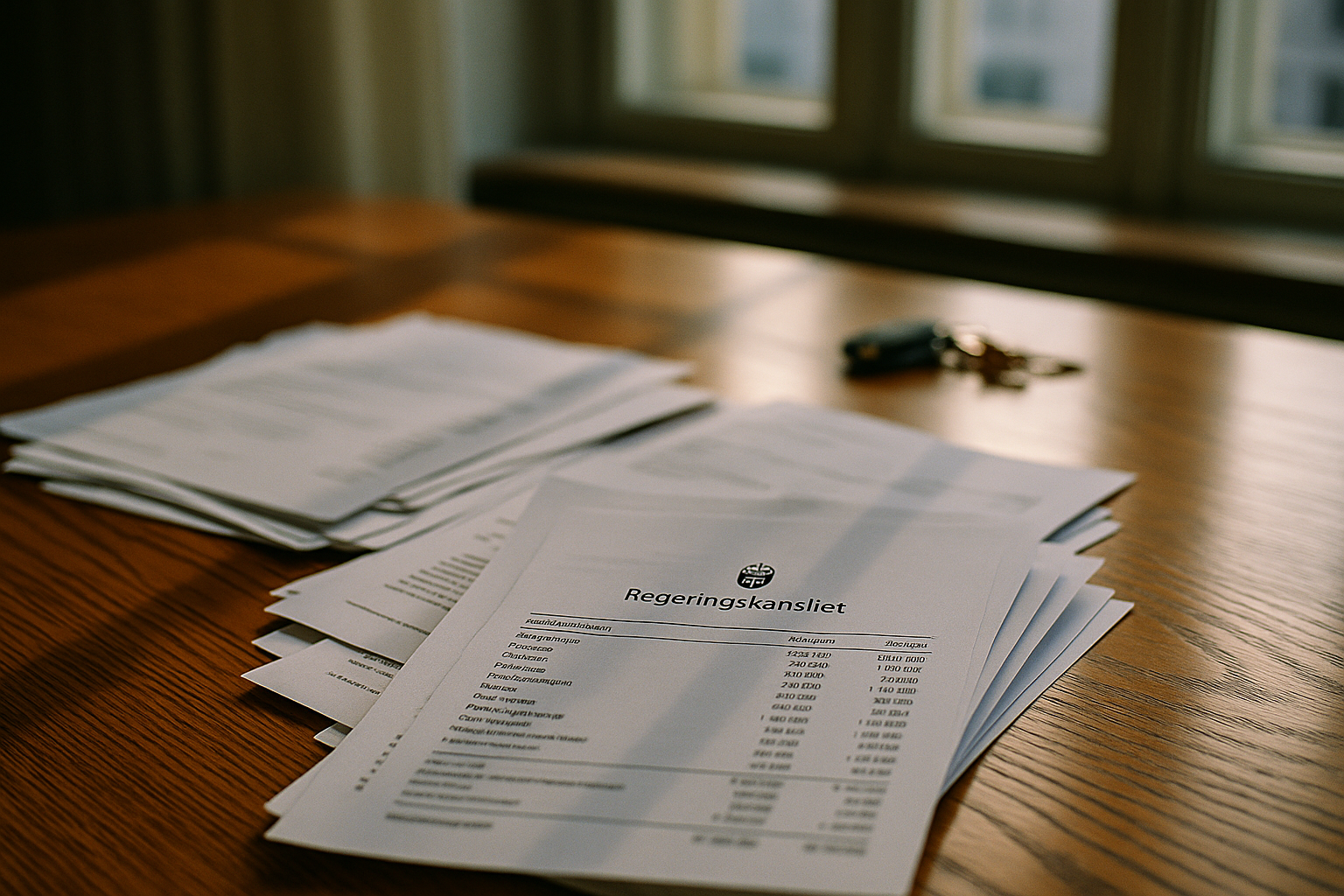
Billström earned 2.4 million kronor privately while collecting 156,000 a month in taxpayer-funded severance
- Billström's company filed an annual report this week showing 2.4 million kronor in turnover during his severance period
- His taxpayer-funded severance totals roughly 1.87 million kronor per year — paid regardless of private earnings
- Sweden's ministerial severance rules contain no means-testing or income cap, unlike stricter Nordic counterparts
- Norway and Denmark both reduce or eliminate severance pay if the recipient takes other employment
Tobias Billström, Sweden's foreign minister from 2022 until the government reshuffle in 2024, turned over more than 2.4 million kronor through a newly formed company during the same twelve-month period he collected a full parliamentary severance package — a so-called fallskärm, or golden parachute — of 156,000 kronor per month from taxpayers. The figures come from the company's annual report, filed this week and first reported by Expressen. The severance alone amounts to roughly 1.87 million kronor over a year — on top of whatever Billström earned privately.
Sweden's severance system for departing ministers and senior parliamentarians is designed to provide a financial cushion during the transition back to civilian life. The stated purpose is to prevent former ministers from making desperate career decisions under financial pressure — or from being tempted to trade on their insider knowledge too quickly. In practice, the system pays out a fixed monthly sum for up to one year, with no means-testing and no reduction if the recipient earns income elsewhere. A former minister can build a thriving consultancy, bill millions, and still draw the full amount from the public purse every month. There is no conflict-of-interest review tied to the payments, and no clawback mechanism.
This stands in contrast to how neighbouring Nordic countries handle the same problem. In Norway, departing government ministers receive severance (etterlønn) for up to three months, after which any continued payments are reduced krone-for-krone against other income. Denmark's system for departing ministers (eftervederlag) operates on a similar principle: the payment shrinks or disappears entirely once the recipient secures new employment. Finland's arrangements for departing ministers are more modest still. The Swedish model is the most generous in the Nordics — and the only one that makes no attempt to check whether the recipient actually needs the money.
Billström is not accused of breaking any rules. He is not even accused of bending them. The system is built this way. The Riksdag (Swedish parliament) sets the terms for its own members' and former ministers' exit packages, votes on its own compensation structures, and administers the payments through its own bureaucracy. External oversight is minimal. The Swedish National Audit Office (Riksrevisionen) can review the system in theory, but has shown limited appetite for scrutinizing the financial arrangements of the political class that appoints its leadership.
The Moderate Party, Billström's own, campaigned in 2022 on fiscal discipline, reducing welfare dependency, and ensuring that public money goes to those who genuinely need it. The party has backed stricter rules for unemployment benefits, tighter requirements for sickness insurance, and activity obligations for welfare recipients — all on the principle that state payments should not flow to people capable of supporting themselves.
Billström's company billed 2.4 million kronor while the state deposited 156,000 kronor into his account every month. The rules worked exactly as designed.
Sources: Expressen