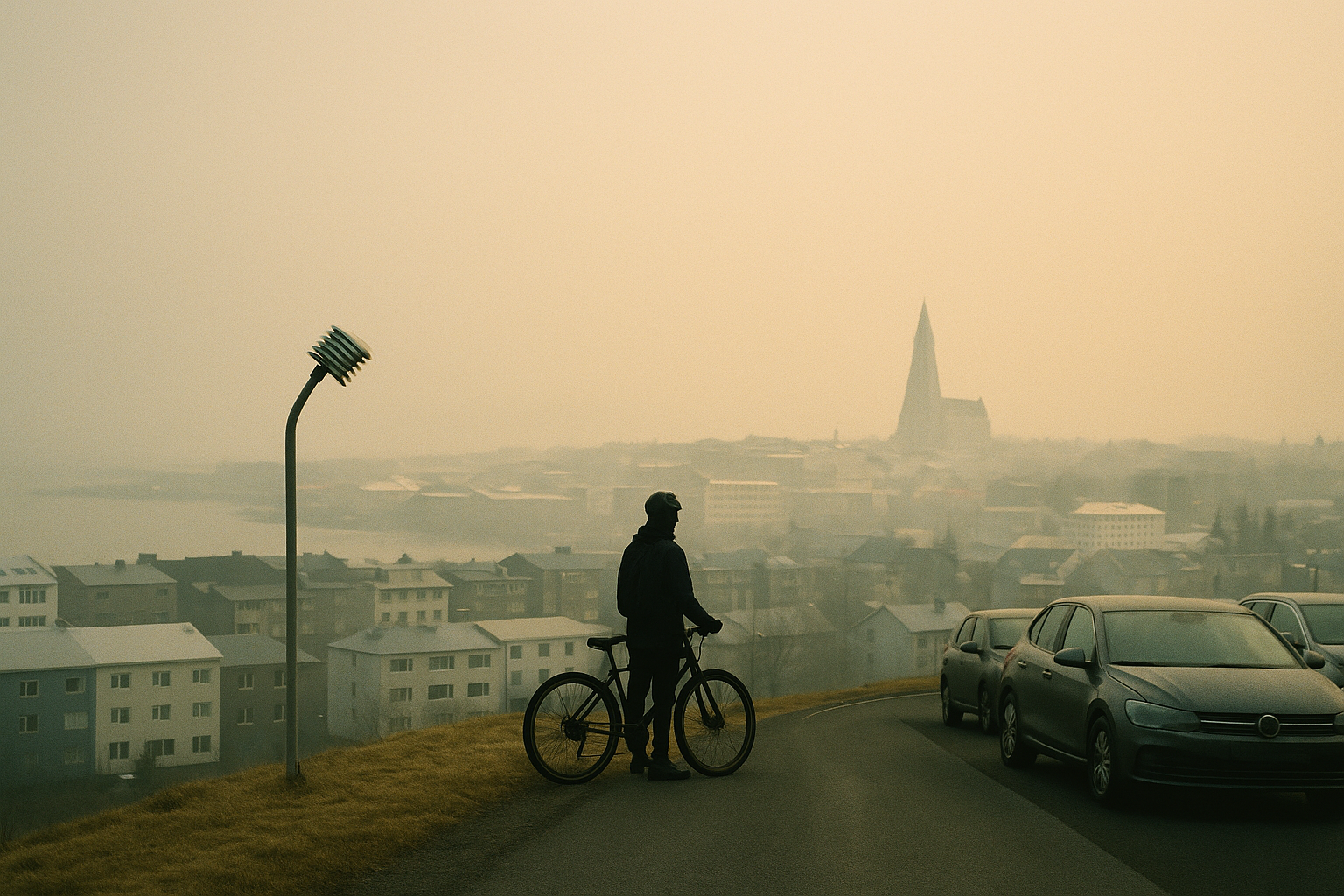
Canadian wildfire smoke reaches Iceland, Reykjavík haze lifts fine-particle levels
- Meteorologist Einar Sveinbjörnsson says back-trajectory modelling points to air arriving from Canada after 5–10 days.
- Fine-particle readings rose in southwest Iceland, while measurements did not match dust or sand drift.
- The haze followed southwesterly winds, ruling out the sea-spray conditions usually seen in autumn and winter storms.
- Sveinbjörnsson says this type of smoke haze may become more common in Iceland as warmer summers drive more fires in North America.
The sky over Reykjavík and the surrounding capital area turned white-yellow on Thursday evening as a thin haze settled over southwest Iceland. RÚV reports that the most plausible explanation is smoke from wildfires in Canada, carried across the Atlantic and into Icelandic airspace.
The immediate clue was what the haze was not. Meteorologist Einar Sveinbjörnsson wrote on his Blika website that winds were from the southwest, with air arriving from the ocean, which rules out the sea-spray haze that usually appears in autumn and winter storms over the Greenland Sea. Air-quality measurements from the southwest also did not show the rise in coarse particulate matter that would be expected from local dust or sand drift. Instead, several monitors registered higher concentrations of fine particles, the profile more consistent with transported smoke.
Sveinbjörnsson said HYSPLIT back-trajectory calculations at 500 and 1,500 metres over the Reykjanes peninsula traced the air mass back to western Canada. On that reconstruction, the particles took roughly five to ten days to reach Iceland. That places Iceland far from the fires themselves but still inside their atmospheric footprint, a reminder that distance offers little protection once smoke rises high enough to enter long-range transport routes.
For Iceland, the episode is less about a single odd-coloured evening sky than about exposure to pollution generated thousands of kilometres away. Canada has had hundreds of wildfires in recent days and weeks, according to RÚV, forcing thousands from their homes. At least 28,000 square kilometres have burned, well over a quarter of Iceland’s land area. When fires reach that scale, smoke does not remain a local problem for long.
No broad public-health warning was cited in RÚV’s report, but the fine-particle readings matter because PM2.5 travels deep into the lungs and usually carries the main health burden in wildfire smoke events. Iceland is accustomed to tracking volcanic gases, dust storms and marine weather; imported smoke from North America adds another source of degraded air that local authorities cannot control and residents cannot see clearly until the sky changes colour.
Sveinbjörnsson told RÚV this kind of haze may become more common in Iceland as warmer summers feed more frequent and more intense forest fires in North America. Thursday’s haze reached Reykjavík after crossing an ocean; the particulate monitors in southwest Iceland still moved first.
Källor: RÚV