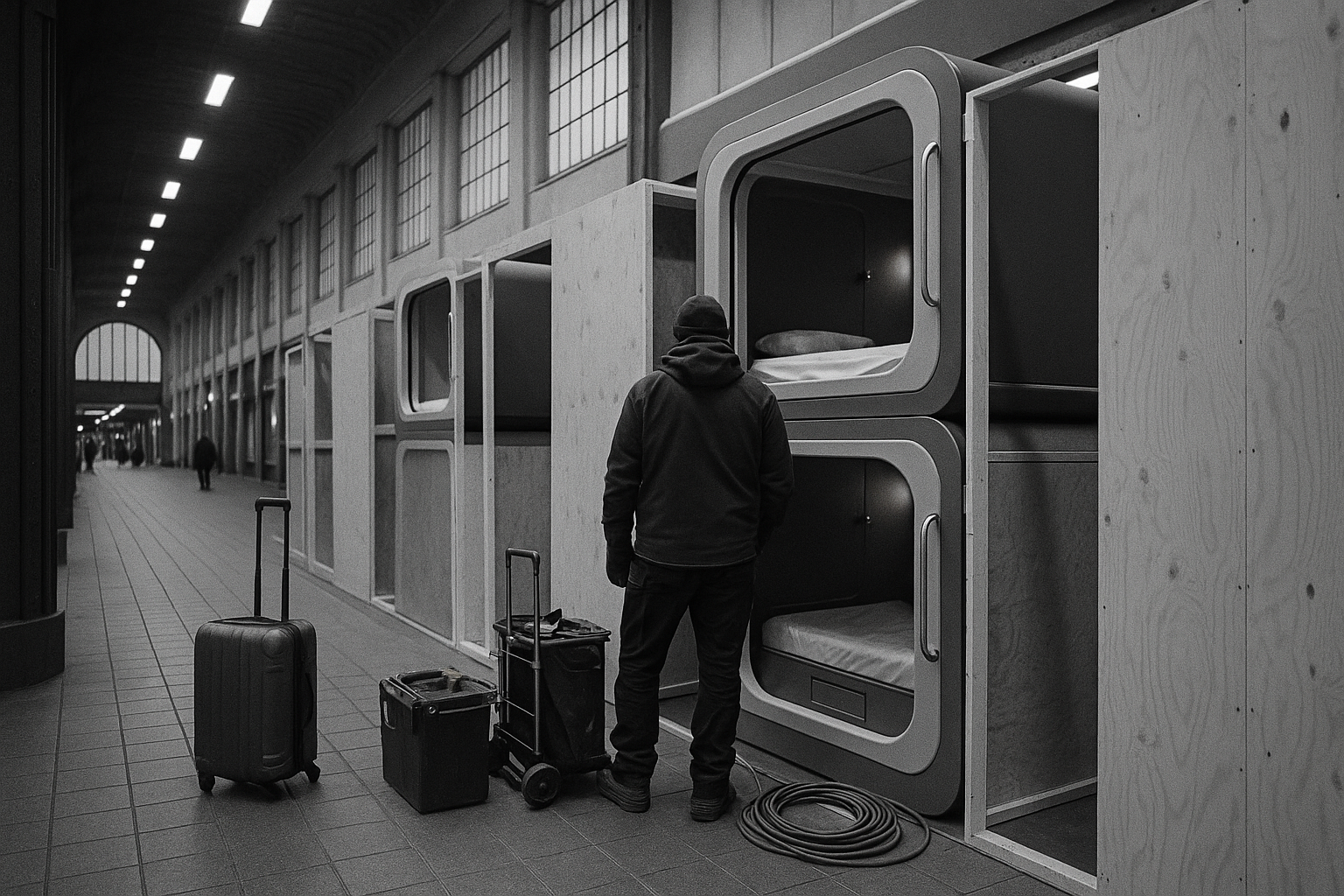
Capsule hotel reaches Helsinki Central Station, YLE reports, 150 lockable units test denser budget lodging
- The operator opened Finland’s first Japanese-style capsule hotel in Tampere last year and is now moving into Helsinki.
- The Helsinki site will add 150 lockable sleeping units at the main railway station.
- The model targets passengers in transit, tourists and customers seeking cheaper central accommodation than standard hotels.
- The project turns station space into revenue-generating lodging in a city where central hotel capacity is expensive.
A Japanese-style capsule hotel that opened in Tampere last year is expanding to Helsinki Central Station, where 150 lockable sleeping units are now being built, YLE reports. The project places ultra-compact accommodation inside Finland’s most prominent rail hub, a building that handles commuters, airport rail passengers, domestic travellers and tourists at all hours.
The novelty is not the Japanese reference point so much as the address. Helsinki’s main station sits in the middle of the capital’s hotel market, where location carries a premium and conventional rooms absorb far more floor area per guest. A capsule model reverses that equation: smaller private units, fewer amenities per customer, higher density per square metre. For a transport hub landlord, that means station space can be turned into overnight inventory rather than waiting areas, retail frontage or offices.
YLE reports that the operator behind the Tampere site is bringing the same concept south after launching what was described as Finland’s first Japanese-style capsule hotel last year. The target market is easy to infer from the location: late-arriving rail passengers, early departures, event visitors, budget tourists and travellers who need a bed in the centre rather than a full hotel stay. Helsinki also has a growing stock of short-stay demand that does not always match the price of standard hotel rooms near the station.
The economics are blunt. A lockable sleeping unit uses less space, less furnishing and less labour than a conventional room, while the station supplies what stand-alone hotels usually have to buy with location. The customer gets a central overnight option at the point where train schedules, airport connections and city foot traffic already converge. The operator gets visibility that no side-street budget hotel can match.
That makes the station a useful test case for compressed urban hospitality. If 150 units fill reliably, the result will be hard to miss: one of Helsinki’s landmark public buildings will also function as a dense, low-cost sleeping facility. If they do not, the city will still have shown what kind of accommodation it was willing to insert into its front door.
The first experiment was in Tampere. The second is going into the capital’s main railway station, 150 doors at a time.
Källor: YLE Uutiset