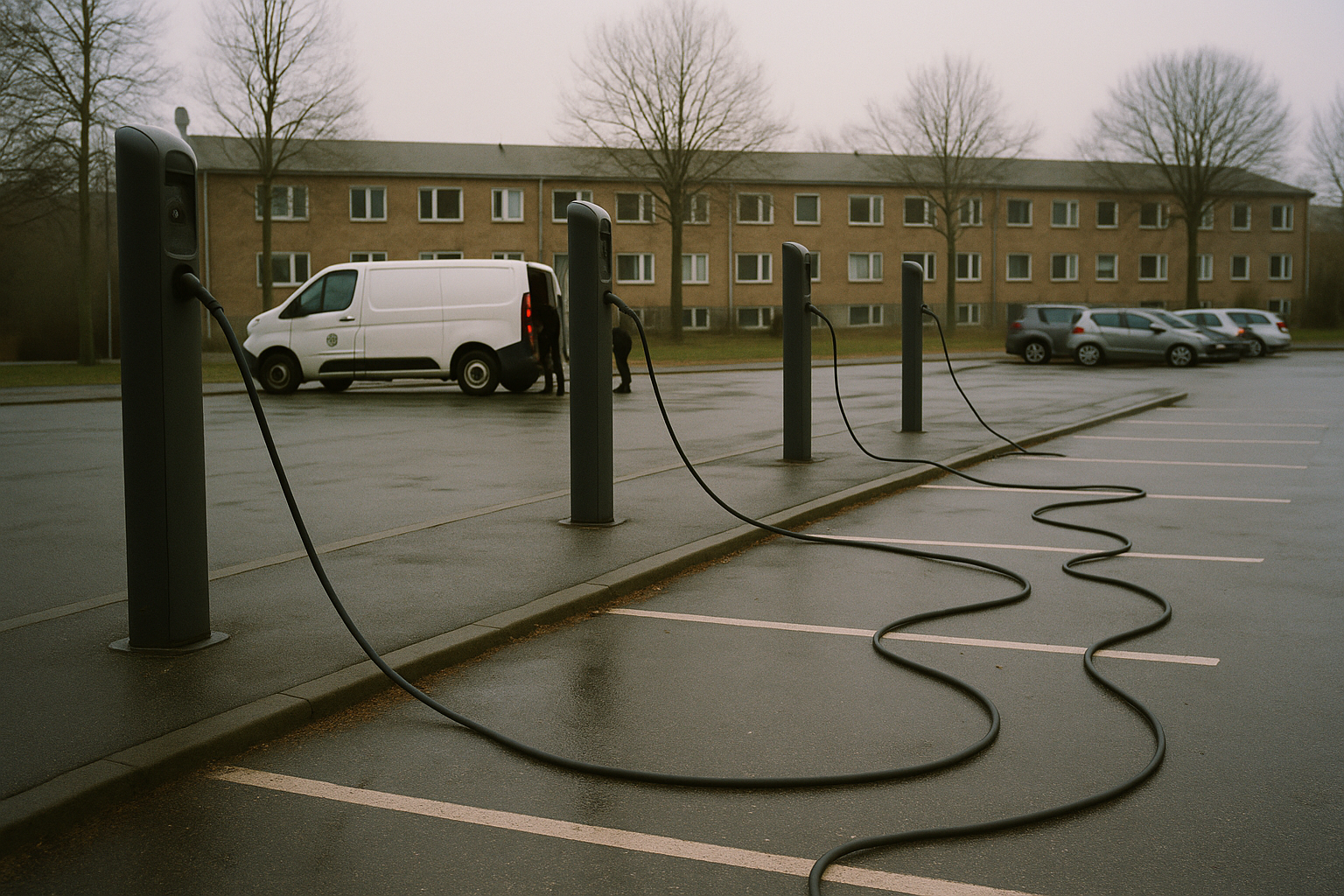
Clever expands charging network, Denmark races toward 1.6 million EVs, municipalities and drivers absorb rollout costs
- Clever plans 3,000 new charging points and projects 1.6 million electric cars in Denmark by 2030.
- The rollout will include apartment complexes, workplaces and public locations, extending beyond motorway fast-charging hubs.
- The pace of charger construction now matters as much as EV sales, especially outside the largest cities.
- Local power capacity, site access and pricing will determine whether expansion feels abundant or constrained for drivers.
Clever plans to install 3,000 new charging points in Denmark, framing the move around an expected national fleet of 1.6 million electric cars by 2030. DR reports that the energy company will expand charging at housing associations, workplaces and public sites, adding another layer to a build-out that has already made roadside chargers a standard part of Danish urban infrastructure.
The number matters less as a headline than as a ratio. If Denmark reaches 1.6 million EVs within five years, each new charging point will be serving a rapidly growing pool of cars, and the pressure will not fall evenly. Drivers with private driveways can charge at home; apartment residents, commuters and motorists in smaller towns depend on shared infrastructure, where queues, detours and peak-hour pricing arrive faster than political targets. A charging network can look dense on a national map and still leave long gaps between viable options once motorway corridors and Copenhagen suburbs are stripped out.
DR describes the expansion as part of a broader electrification push rather than a state construction program, which places private capital at the centre of the rollout. That does not make the public sector irrelevant. New sites still need permits, parking space, grid connections and, in many cases, local acceptance when curb space is reassigned from ordinary parking to charging bays. If transformers, substations or distribution lines need upgrades, the bill does not disappear; it moves through network tariffs, municipal planning budgets or end-user prices.
The commercial logic is also uneven. Fast chargers along major routes can capture high turnover and higher margins. Residential districts outside the largest cities may offer lower utilization and slower payback, even where the need is growing. That leaves a familiar split: the most profitable locations get built first, while less dense areas wait for either patient capital, local partnerships or some form of public support. Denmark’s EV transition is now far enough along that the bottleneck is shifting from car sales to the less glamorous work of power capacity, land access and charger uptime.
Clever’s 3,000 new charging points show that Denmark’s charging network is still expanding at industrial scale, not pilot-project scale. They will also test whether a country planning for 1.6 million electric cars can keep charging ordinary enough that drivers notice the queue less than the green paint on the parking bay.
Källor: DR Nyheder