Danish cycling group backs road riding, rising e-bike crashes expose limits of bike-lane model
- Cyklistforbundet argues that some faster cyclists should ride on the road rather than on congested bike lanes.
- The proposal comes as bicycle accidents rise, with e-bikes featuring heavily in the increase.
- Critics say sending cyclists into car traffic shifts risk rather than solving the shortage of space.
- The dispute has widened into a question of who gets priority in Danish urban streets: cyclists, motorists, or municipal traffic planners.
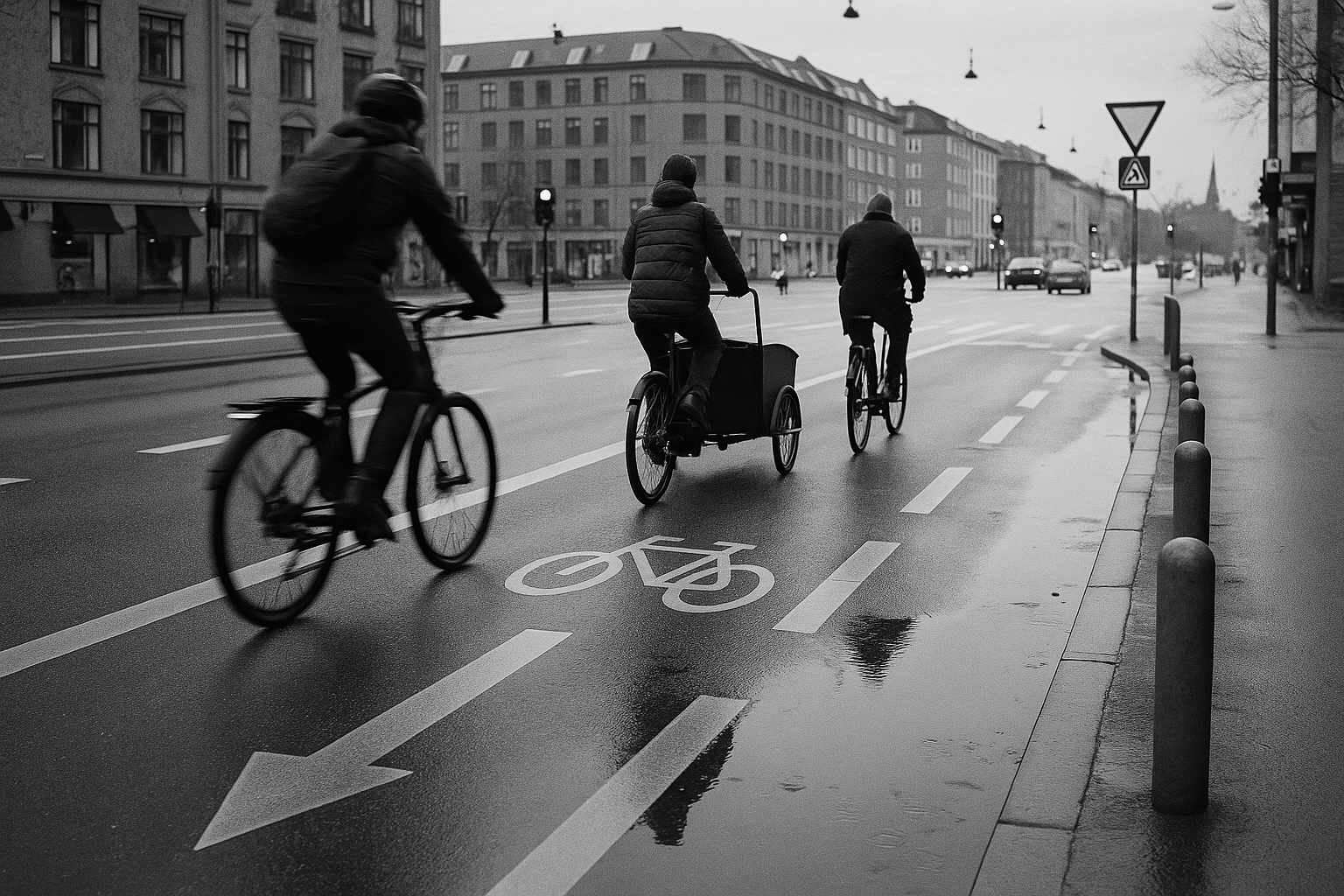
Denmark’s best-known cycling lobby wants some cyclists off the bike lane and into the road. In Jyllands-Posten’s reporting, Cyklistforbundet argues that faster riders should be allowed, and in some cases encouraged, to use the carriageway as congestion on bike paths worsens and bicycle accidents rise, especially those involving e-bikes.
The proposal cuts into one of Denmark’s civic certainties: that the bike lane is where cyclists belong, and that more cycling automatically means safer streets. That bargain becomes harder to maintain when the same narrow strip must absorb schoolchildren, cargo bikes, commuters, elderly riders and electric bicycles travelling at very different speeds. A lane designed around ordinary pedal traffic now carries vehicles that accelerate faster, weigh more and close gaps more quickly. The result is overtaking, braking and side-swiping in space that municipalities largely fixed years ago.
Cyklistforbundet’s answer, as described by Jyllands-Posten, is to spread cyclists across the street network rather than keep every bicycle on the same lane. That would require motorists to accept that the carriageway is not reserved for cars, a point embedded in the article’s headline quote that many drivers treat the road as their own. Opponents are unconvinced. Sending a rider from a protected lane into mixed traffic with cars and vans does not create more space; it reallocates exposure. The arithmetic is plain enough: one bottleneck on the bike lane is exchanged for a speed differential against motor traffic on the road.
The dispute also exposes a planning problem that reaches beyond one advocacy proposal. Copenhagen and Aarhus have spent decades building cycling systems that work well when volumes are high and speeds are fairly uniform. E-bikes alter that equation. They extend commuting range, bring more riders into the system and compress travel times, but they also make old infrastructure look smaller. Municipalities can ask faster cyclists to merge with cars, or they can build wider and more separated routes for different speeds. The first option is cheaper and quicker on paper. The second demands street space that cities have been reluctant to take from cars, parking or pavements.
That leaves a familiar urban contest over priority. Cyclists want safe passage, motorists resist losing road space, and city planners are left rationing a corridor that now carries more users than it was built for. Denmark’s cycling model still moves large numbers of people efficiently. It is now being asked to sort 25-kilometre-per-hour e-bikes and ordinary bicycles on the same strip of asphalt.
The proposal starts with crowded lanes and rising accident numbers. It ends with a faster cyclist being told to leave the bike path and take a place between the cars.
Källor: Jyllands-Posten