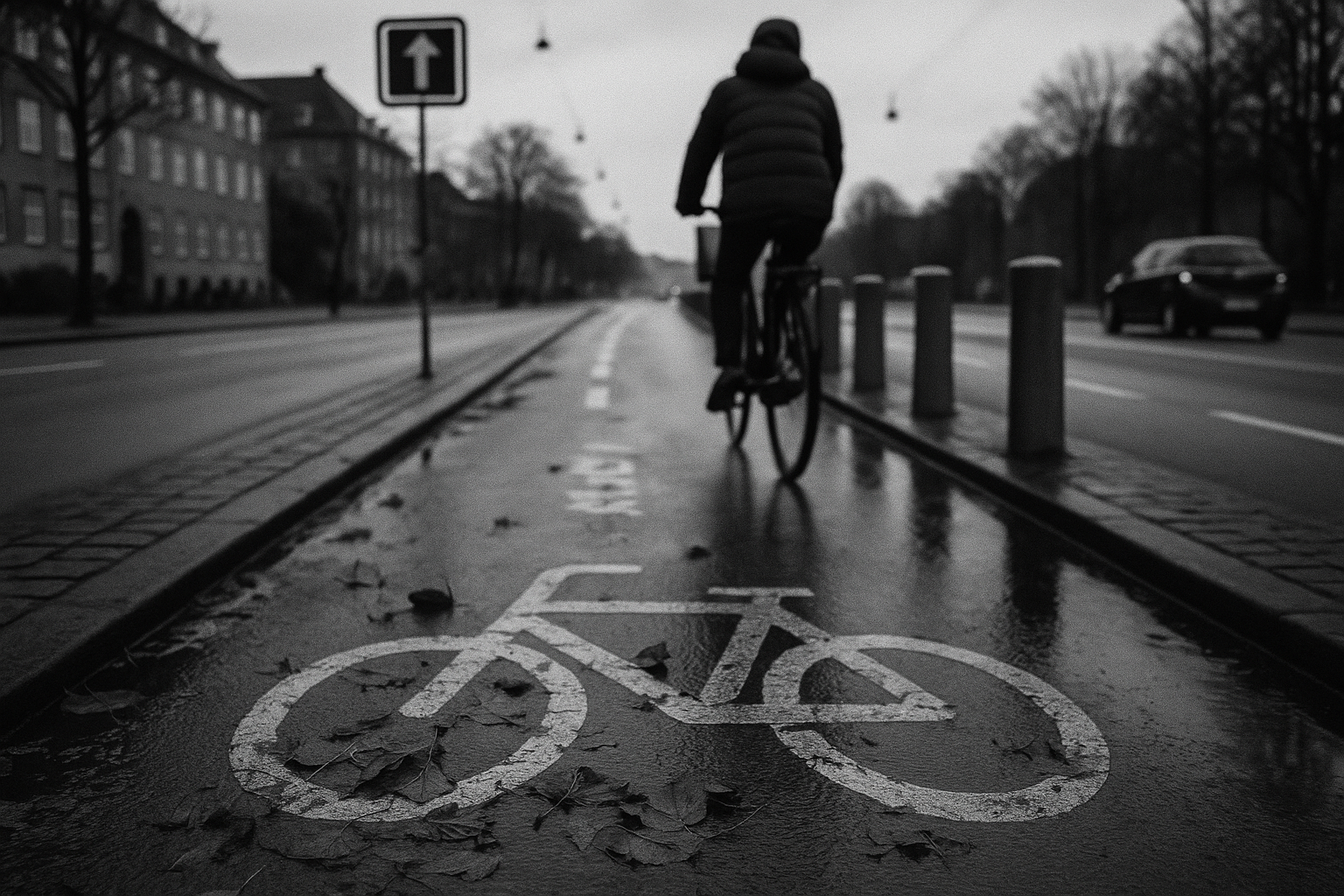
Danish cyclists push lane split, 30 km/h city limits return to debate, municipalities resist broad rewrite
- The Danish Cyclists’ Federation says mopeds, cargo bikes and some faster riders should in some cases use the carriageway instead of crowded cycle lanes.
- Its chairman has also revived the call for 30 km/h speed limits in urban areas, alongside a redistribution of street space.
- Municipalities say street design matters as much as posted speed and warn against one national model for very different roads.
- The dispute mirrors a wider Nordic problem: how to protect vulnerable road users without freezing traffic on streets built for several competing uses.
Crowded cycle paths in Danish cities have produced a familiar argument with a sharper edge: some cyclists should be taken off the cycle lane. DR reports that the Danish Cyclists’ Federation wants selected two-wheeled users moved onto the carriageway and, at the same time, wants urban car speeds reduced to 30 km/h.
The federation’s chairman, writing via an interview cited by DR from Jyllands-Posten, points to the growing mix on Danish cycle infrastructure: conventional bicycles, electric bikes, cargo bikes and mopeds sharing the same narrow strips through dense city traffic. The organisation argues that this mix creates speed differences and overtaking conflicts on cycle paths built for a calmer and more uniform flow. The riders most likely to be shifted are not ordinary commuters on every street, but faster or bulkier two-wheeled users on roads where cycle lanes have become too cramped for the traffic they now carry. The idea is to sort traffic by speed and mass rather than keep every bicycle-shaped vehicle in the same lane. That only works, however, if the adjacent carriageway is slow enough that mixing with cars does not simply move the danger a few metres to the left.
That is where the 30 km/h question returns. Lower urban speeds reduce stopping distance and crash energy, and the difference between a collision at 30 km/h and one at 50 km/h is measured in hospital admissions rather than inconvenience. But municipalities cited by DR do not treat a lower speed sign as a complete answer. Local officials point to the shape of the street itself: lane width, junction design, parking layout, sight lines and whether there is space to separate children, commuters, delivery bikes and cars at all. A city can post 30 km/h on a street still designed to invite 45.
The argument is also about road space, not just safety. If fast e-bikes, mopeds or large cargo bikes leave the cycle path, the remaining lane becomes calmer for schoolchildren and slower riders. If they enter a carriageway still dominated by cars, drivers lose space and speed. Someone pays for that trade. In central districts with heavy cycling volumes, the pressure falls on motorists first; on outer urban roads, municipalities appear less eager to force mixed traffic where distances are longer and car dependence higher.
For Nordic cities, the Danish dispute is less exotic than it sounds. Stockholm, Oslo and Helsinki all promote cycling while trying to keep buses, deliveries and commuter traffic moving on streets that were rarely designed for all of it at once. Denmark’s edge is that it already has the cycle traffic volumes others are still chasing. When even Copenhagen-style infrastructure starts sorting riders by size and speed, the old formula of “build a bike lane and the problem is solved” looks thin.
The proposal begins with congestion on the cycle path, but it ends with a simpler question: which users a city asks to carry the risk. On a narrow urban street, that decision can be read in a painted line and a speed sign.
Källor: DR Nyheder