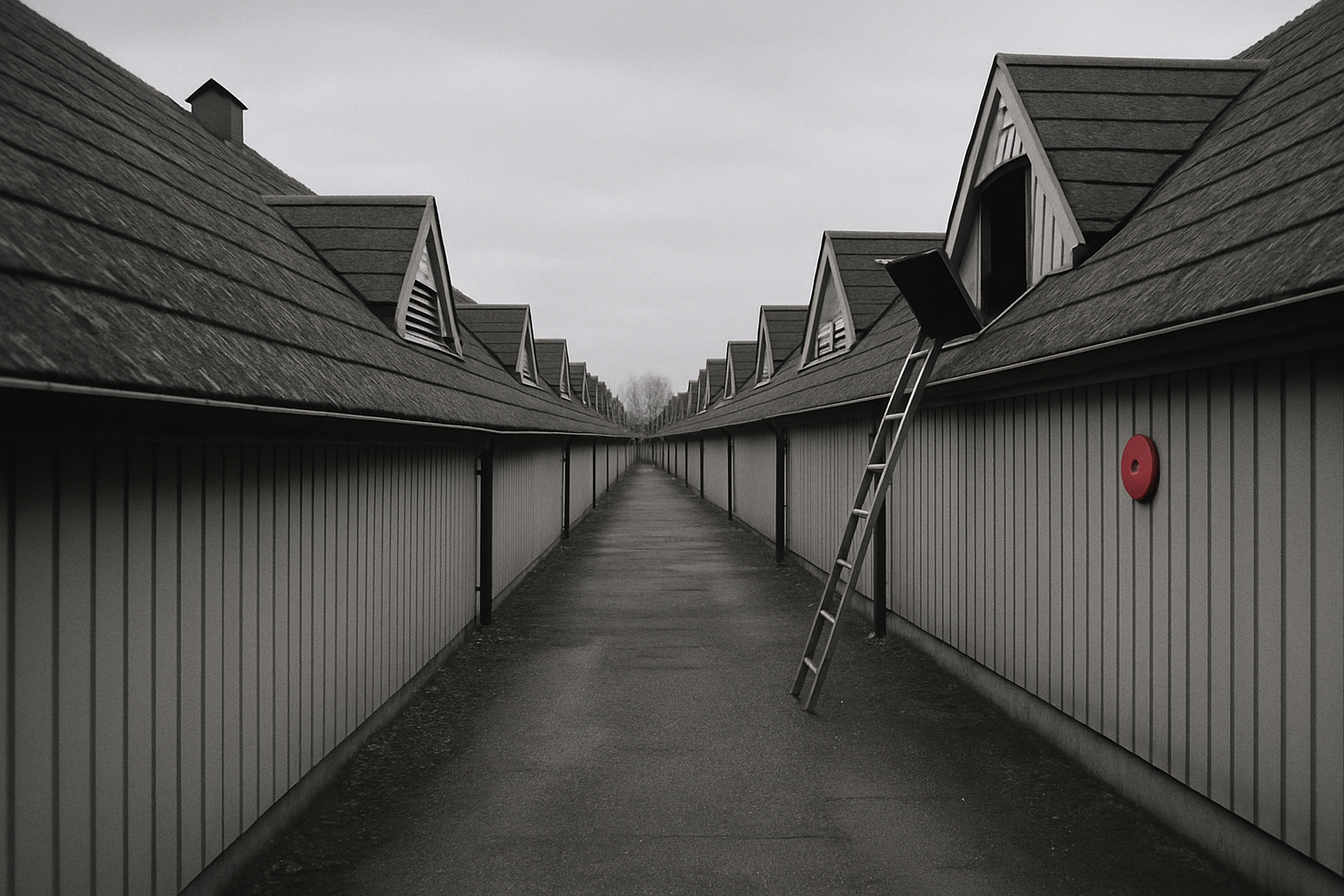
Drammen fire revives Swedish row-house risk, Krusboda shows scale, 1960s attic designs still carry flame
- Ekot links the Drammen fire to older Swedish row-house areas built with continuous attic spaces and limited fire compartmentalization.
- Krusboda in Tyresö is one of Sweden’s largest row-house districts, with more than 1,500 homes from the late 1960s.
- A resident who lost her home in a fire there ten years ago described returning to a grey, soot-covered scene after the blaze.
- The renewed question is whether municipalities and housing associations have upgraded attic separation, fire cells and evacuation routines before another large fire tests them.
A major fire in Drammen has pushed an old Swedish housing risk back into view. Sveriges Radio Ekot reports that older row-house estates in Sweden share the same features now under scrutiny in Norway: long connected attic spaces, weak fire compartmentalization and building layouts that can help a local fire move across multiple homes.
The Swedish example Ekot highlights is Krusboda in Tyresö municipality, south of Stockholm, one of the country’s largest row-house areas with more than 1,500 dwellings. Much of it was built in the late 1960s, the same period as several of the houses affected in Drammen. That matters because the building logic was often the same across the Nordic mass-housing boom: standardized construction, repeated units and shared structural voids above the homes, efficient to build and less forgiving once smoke and heat reach the roof space.
Krusboda has already had its own warning. Ekot cites Riitta, a resident who lost her home in a fire there ten years ago. When she returned, she described the scene as grey and covered in soot, the kind of damage that leaves little doubt about how far a fire can travel once it gets beyond a single unit. In these estates, the question is not only how a fire starts but what stops it after the first wall and the first ceiling fail.
For municipalities, tenant-owner associations and housing cooperatives, that turns the issue from architecture into maintenance and cost. Upgrading older row houses can mean cutting attic continuity, strengthening fire separation between homes, improving alarms and escape routes, and checking whether residents know how evacuation works when several units are affected at once. The bill falls on local owners and associations, while the alternative is visible in every post-fire image: one ignition point, then a line of blackened roofs.
Sweden has no shortage of these neighbourhoods. The row-house expansion of the 1960s and 1970s produced large suburban districts around Stockholm and other cities, many still structurally close to their original form. The Drammen fire has not created the vulnerability. It has provided a current image of what older Nordic row-house design can do under heat.
In Krusboda, more than 1,500 homes still stand in long rows first built at the end of the 1960s. The attics were cheaper to leave connected than to rebuild later.
Källor: Sveriges Radio Ekot