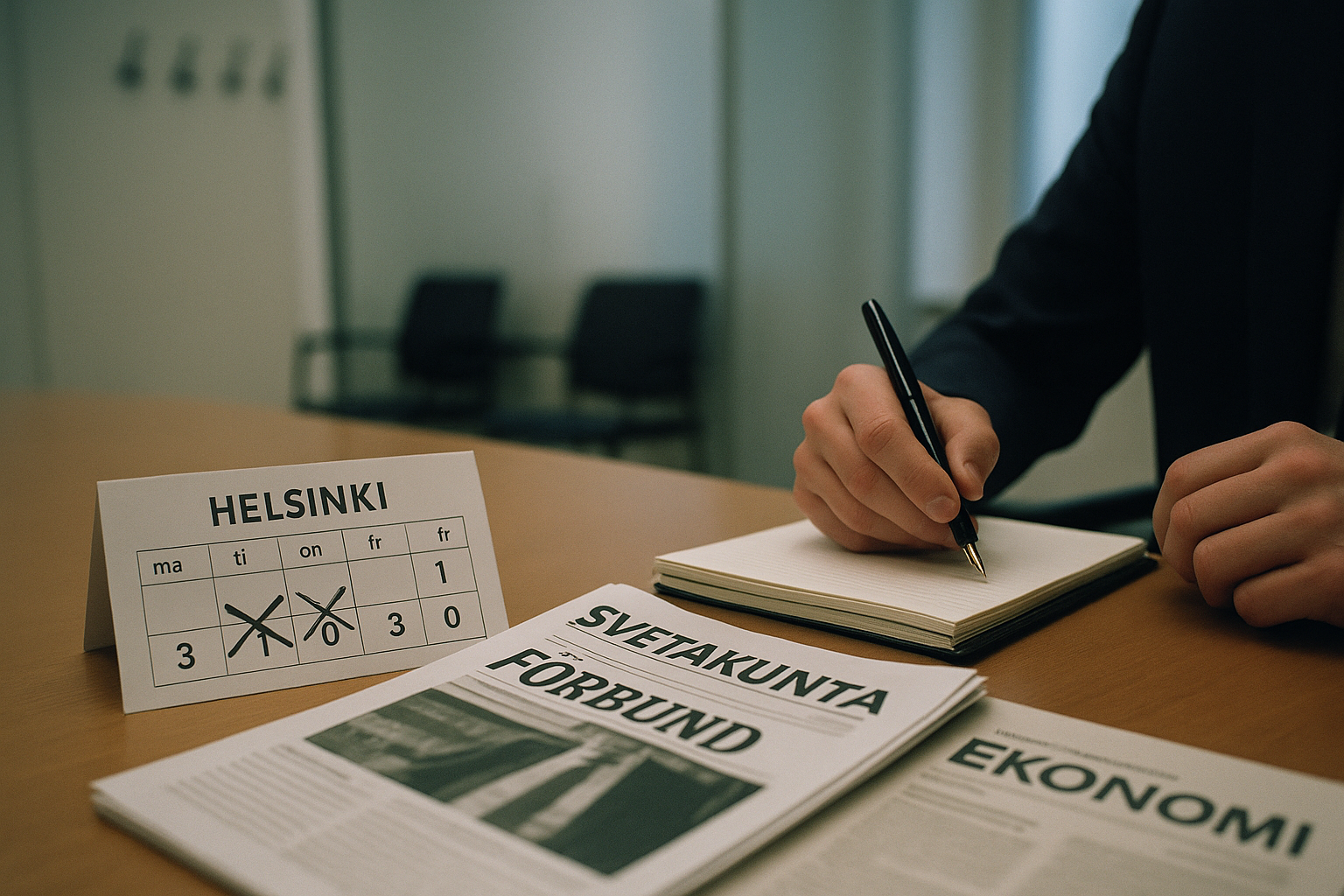
EK revives holiday cuts, Finland opposition targets Orpo denial
- The Confederation of Finnish Industries (EK) proposed scrapping Epiphany and Ascension Day as weekday public holidays.
- EK also wants statutory overtime and Sunday pay supplements cut in the next parliamentary term.
- SDP leader Antti Lindtman used parliament’s question time to challenge Orpo’s claim that the issue is not on the National Coalition Party agenda.
- The dispute sharpens a broader argument over whether Finland’s competitiveness should come from lower labour compensation or from employers absorbing higher costs.
Finland’s employer lobby has reopened one of the country’s oldest labour disputes with a blunt list of cuts: two public holidays gone, overtime premiums reduced, Sunday compensation trimmed. According to Iltalehti, the Confederation of Finnish Industries, EK, said on Thursday that working time should be extended in the next parliamentary term by removing Epiphany and Ascension Day as weekday public holidays and by cutting statutory overtime and Sunday pay supplements.
The proposal landed immediately in party politics. Social Democratic Party leader Antti Lindtman raised it in the Finnish parliament’s question time, where the scheduled topic was young people’s confidence in the future. Instead, the exchange turned to whether Prime Minister Petteri Orpo’s National Coalition Party is saying one thing in government while its allies in the employer camp test another line in public. SDP is now using EK’s intervention to press on an exposed point before next spring’s elections: if these cuts are not on the government’s agenda, why are they being floated so openly by the country’s most influential business organisation.
The substance is plain enough. Removing weekday public holidays adds working hours without changing monthly pay. Cutting statutory overtime and Sunday premiums lowers the price of inconvenient hours that employers now pay extra for. For companies, that means lower labour costs and more room in margins. For workers in retail, logistics, hospitality, health care and industrial shift work, it means less compensation precisely where schedules are hardest to fill and family time is already sold at a premium.
That is why the argument reaches beyond two holidays on the calendar. Finland has spent years debating competitiveness through wage restraint, social insurance changes and labour-market reforms. EK’s latest package pushes the same question in a more visible form: whether the next round of cost-cutting should come from reducing legally protected supplements rather than from productivity gains, investment or sector-by-sector bargaining. The government does not need to endorse the proposal for it to shape the campaign. A business lobby places the bid on the table; the opposition asks who sent it there.
Orpo’s difficulty is political as much as economic. His government can deny that holiday removals and premium cuts are being prepared, but the proposal comes from an organisation closely aligned with employer interests that the centre-right has long treated as serious company. That leaves the prime minister defending distance from a plan that fits the broader drive for lower labour costs, while the opposition is handed a concrete list of what “competitiveness” can mean on a payslip.
In this case the concrete list is short enough to fit on a rota: Epiphany, Ascension Day, overtime hours and Sundays.
Sources: Iltalehti