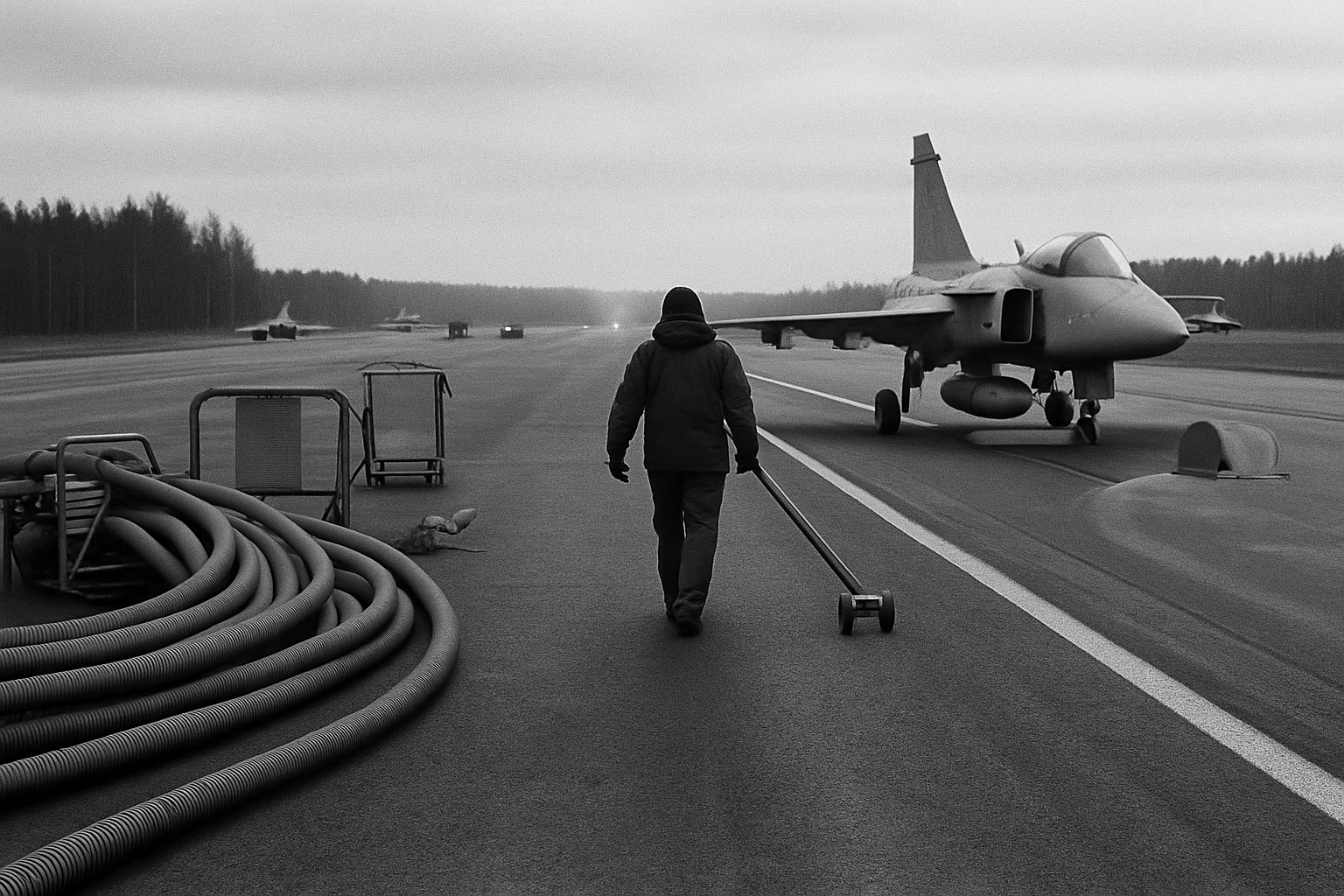
Finland hosts NATO air surge, 50 foreign aircraft test frontline role, wartime access runs through civilian fields
- YLE reports that more than 50 foreign military aircraft are coming to Finland for a nearly two-week NATO air exercise.
- The exercise tests Finland’s ability to integrate allied aircraft, crews and support chains under operational conditions.
- Finnish wartime planning relies on dispersed operations, which puts attention on roads, secondary airfields and civilian infrastructure.
- The drill shows how much air defence now depends on access, logistics and multinational reinforcement, not only on Finland’s own fleet.
More than 50 foreign military aircraft are coming to Finland for a NATO air exercise lasting nearly two weeks, a deployment that turns the country from new member into operating base. YLE reports that the exercise area runs from Northern Europe to Spain and that Finnish observers can expect to see a broad mix of allied aircraft on and around Finnish bases.
The immediate spectacle is easy enough to grasp: foreign jets, support aircraft and crews arriving in numbers large enough to alter normal air traffic at military bases. The harder question sits behind the flight line. Receiving dozens of allied aircraft on short notice means parking space, fuel, munitions handling, ground crews, force protection, runway capacity, command links and secure communications all have to work at once. A country can buy fighters over decades; it has far less time in a crisis to prove that foreign squadrons can land, disperse and fly combat sorties from its territory without delay.
That is what this exercise measures. Finland has long built its air defence around dispersal and wartime mobility, using multiple operating locations rather than a handful of fixed main bases. NATO membership adds a new layer: the same network must now absorb foreign aircraft and foreign maintenance chains, while fitting them into Finnish command arrangements and airspace control. The exercise therefore says as much about host-nation support as about flying skill. Every tanker truck, hardened shelter, security cordon and data link becomes part of the combat system.
The geography matters. Finland sits on NATO’s northeastern edge, close to Russia and far from the larger air bases of Central Europe. Reinforcement by air is fast only if bases are ready before the crisis starts. That pushes attention onto logistics and infrastructure that look civilian until they are suddenly military: roads feeding bases, local fuel supply, rail links, power, telecommunications and nearby airports that can support overflow or emergency use. The aircraft may be military; much of the system keeping them airborne is not.
The exercise also sharpens an old defence question in a new form. Finland still fields its own air force and is replacing its F/A-18 Hornets with F-35 fighters, but a large NATO drill on Finnish soil shows how much deterrence now rests on multinational mass. More aircraft raise the cost of attack. They also raise dependence on outside crews, spare parts, common procedures and political decisions made beyond Finland’s borders. Autonomy in peacetime procurement is one thing; autonomy under sustained air operations is another.
For residents near bases, the visible part will be noise, unfamiliar silhouettes and tighter security. For planners, the visible part is less interesting than the turnaround time between landing and next sortie. More than 50 foreign aircraft on Finnish soil is not a symbol. It is a parking, fuel and runway problem measured in hours.
Källor: YLE Uutiset