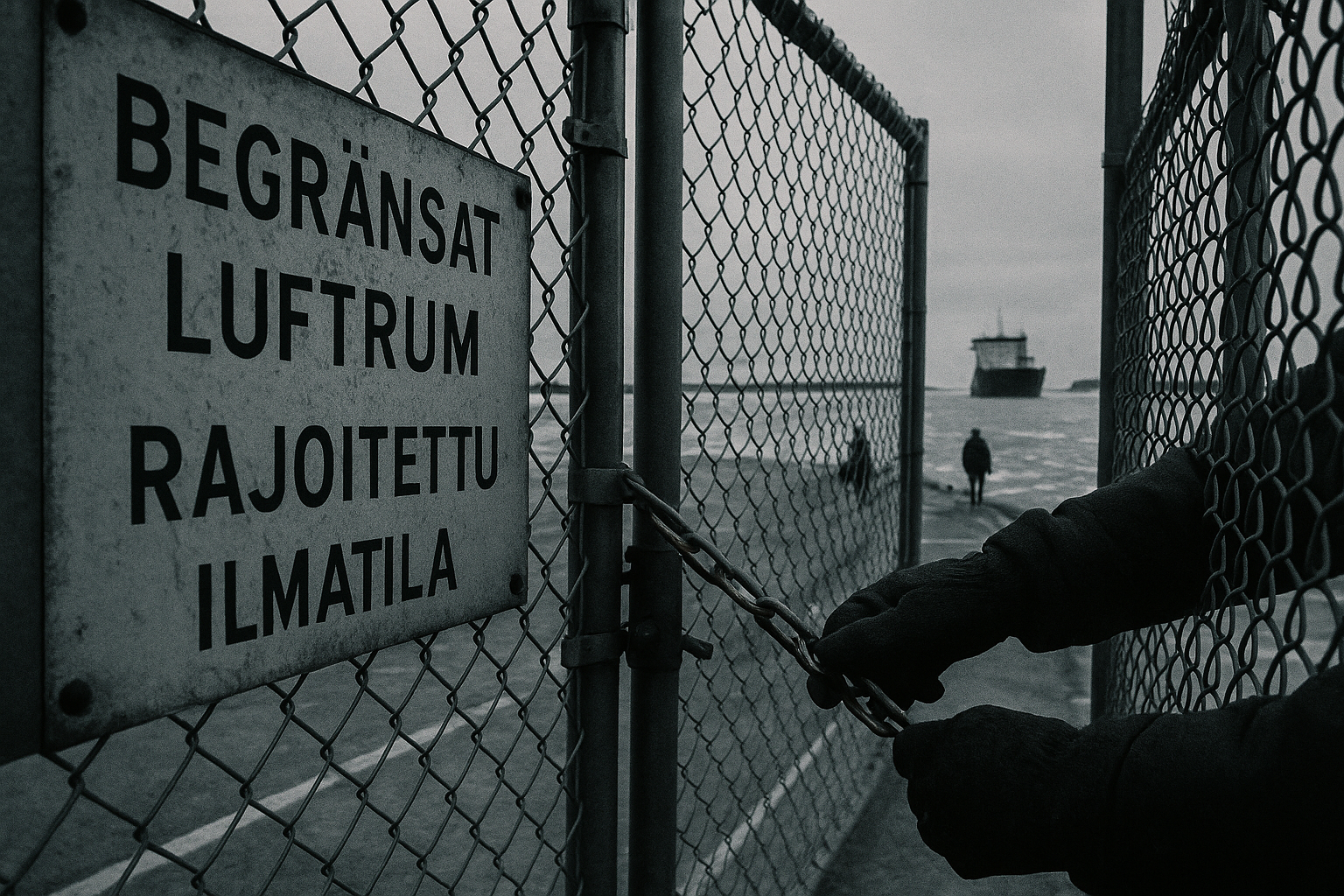
Finland restricts airspace off Kotka-Hamina, southeast coast tightens under Ukraine war security measures
- The restricted area is located at sea off Kotka-Hamina on Finland’s southeastern coast.
- The Defence Forces say the measure is linked to the security environment created by Russia’s invasion of Ukraine.
- The announcement points to tighter control around a strategically exposed coastal corridor near the Russian border.
- The immediate practical questions are duration, scope and effects on civilian operators.
Finland’s Defence Forces are temporarily restricting air traffic in a maritime area off Kotka-Hamina, on the country’s southeastern coast. YLE reports that the measure is explicitly tied to the war-related security environment created by Russia’s invasion of Ukraine.
The restriction covers sea airspace outside Kotka-Hamina, a stretch of coast that combines commercial port operations, nearby border infrastructure and military relevance. That matters because the area is not a remote training zone: it sits beside one of Finland’s busiest freight corridors, where civilian shipping, surveillance, coastal defence and cross-border sensitivities already overlap. A temporary restriction in that setting does more than reroute a few flights. It marks a willingness to reserve room for military activity or precautionary control in an area where the margin for error has narrowed since 2022.
YLE’s report does not, in the material published so far, spell out the full operational details that local pilots and operators would want first: the exact dimensions of the restricted zone, the hours of enforcement, which categories of flights are exempt, and how long the arrangement will remain in force. Those details will determine whether the measure is mostly an administrative notice to general aviation or a more meaningful constraint on traffic planning along the coast. For Kotka and Hamina, the distinction matters. The twin-port area handles large cargo volumes, and even a temporary tightening around adjacent airspace signals how closely civilian logistics now sit beside defence requirements.
The official explanation also places the move inside a broader shift in Finnish security policy. Since Russia’s full-scale invasion of Ukraine, Finland has expanded border surveillance, accelerated defence planning and treated southeastern Finland less as a peripheral region than as an active security frontier. Temporary restrictions, closures and special-use zones are one way states create room for readiness without announcing every operational reason in public. The cost is borne locally first: pilots refile routes, operators absorb delays, and coastal business works around a map that can change faster than peacetime habits assume.
Whether this proves to be a one-off precaution or part of a wider pattern will depend on what follows in notices to airmen, maritime advisories and any repeat use of similar zones elsewhere on the Finnish coast. For now, the concrete fact is narrow and clear: the Defence Forces have set aside a piece of airspace over the sea off Kotka-Hamina because the war in Ukraine has reached into the routines of southeastern Finland.
Källor: YLE Uutiset