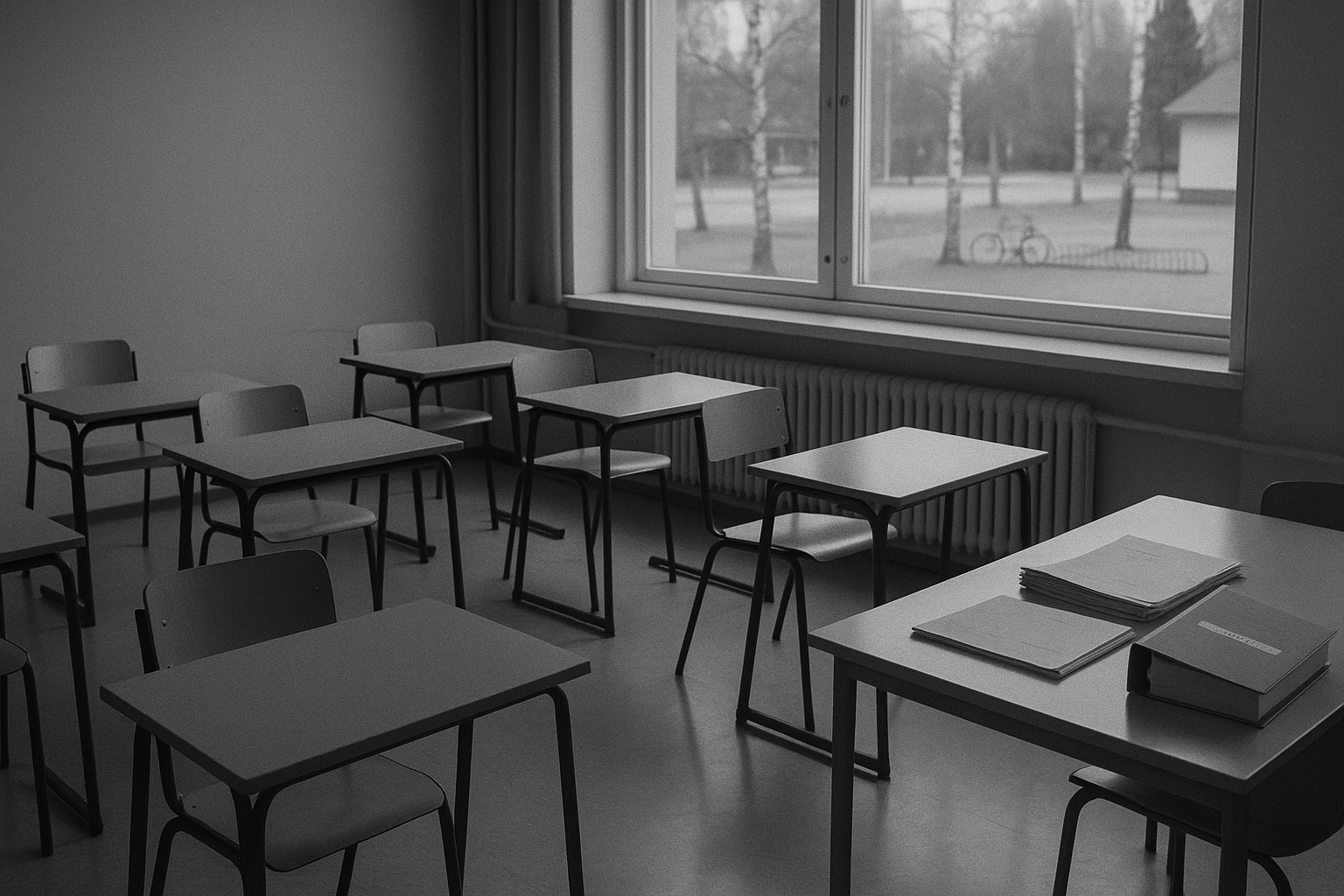
Finnish upper secondary rolls shrink, municipalities face school closures, state funding model comes under pressure
- YLE reports that the Association of Finnish Local and Regional Authorities expects upper secondary schools to be closed as enrolment declines.
- The pressure falls first on smaller municipalities, where a lukio often doubles as a local service and a retention tool for families.
- As student numbers fall, fixed costs are spread across fewer pupils, pushing up per-student spending.
- Longer travel times and fewer local study options are likely to hit rural and peripheral areas before the big cities.
Finland’s upper secondary school network is heading for contraction as age cohorts shrink and municipal budgets tighten. YLE reports that a new assessment from Kuntaliitto, the Association of Finnish Local and Regional Authorities, expects lukios — Finland’s general upper secondary schools — to be closed as student numbers collapse.
The arithmetic is harsh and mostly fixed. A school still needs premises, teachers, administration and student services even when each incoming class is smaller than the last. In a large city, that can be absorbed across a wider network. In a small municipality, one lukio may sit at the edge of viability for years and then fall below it all at once. What looks like an education policy debate is also a municipal finance problem: local authorities are being asked to preserve a full-service map with a thinner tax base and fewer teenagers.
The first closures are likely to come outside the growth centres. Helsinki, Tampere and other larger urban areas still draw young families and students from surrounding regions. Smaller towns in eastern and northern Finland, and municipalities already losing working-age residents, have less room to spread costs. A lukio in those places is more than a school. It helps keep 16-year-olds in the municipality, supports local bus routes, and gives families one less reason to move. Once it closes, the next nearest option may be in another town, with daily travel measured in hours rather than minutes.
That shifts costs rather than removing them. Students who commute farther need transport. Some may need accommodation away from home. Municipalities that lose a lukio can also lose households that prefer to settle where upper secondary education exists locally. The school budget shrinks on paper; the municipality’s long-term revenue base can shrink with it. A building with a gym, classrooms and a staff room remains, even after the timetable is gone.
YLE says the Kuntaliitto report points to a steep fall in the number of upper secondary students. That raises a second question: whether the state funding model is speeding up consolidation by rewarding volume and making small units harder to sustain. A formula built around enrolment will always favour larger centres when cohorts decline. Municipal leaders can defend local schools for a time, but each missing class makes the subsidy thinner and the local top-up larger.
Across the Nordics, demographic decline is forcing the same sequence of decisions: first maternity wards, then primary schools, then upper secondary schools and health services. Finland’s lukio network is now entering that stage. The closures will begin where the next school is already a bus ride away.
Källor: YLE Uutiset