Grid queues stall Danish electrification, Jyllands-Posten warns of political bill coming due
- Electric buses, freight operators and industrial users are waiting for grid connections that may take years.
- A cement company seeking lower-emission production is looking at diesel generators as a temporary workaround.
- The bottleneck shifts the green transition from a question of technology to one of scarce network capacity and political prioritisation.
- The next Danish government risks inheriting the cost of promises made faster than the grid was expanded.
Denmark has electric buses ready to run, freight operators ready to plug in and industrial companies ready to replace fossil fuel use, but the wires are missing. In a podcast report, Jyllands-Posten reports that projects billed as part of the country’s green transition are stuck in connection queues, with some facing waits so long that diesel generators are being discussed as an interim solution.
The examples are concrete. Electric buses cannot get access to the power they need. A cement producer that wants to make lower-carbon cement is, according to the report, looking toward black diesel generators while waiting for a place on the grid. Trucks are ready to move from diesel to electricity, but cannot be connected either. The constraint is no longer whether the vehicles or industrial processes exist. It is whether the transmission and distribution system can carry them.
That changes the economics quickly. A bus fleet bought for electrification but left waiting still has to operate. A cement plant cannot suspend production until a cable arrives. Freight companies that have invested in electric vehicles or charging plans still need to move goods on schedule. If the grid connection is delayed, the fallback is not an elegant bridge technology but the old fuel bill, often with extra capital costs on top. The public sales pitch is decarbonisation; the operating reality can be diesel plus stranded investment.
The queue also creates a political allocation problem. When capacity is scarce, someone decides which projects move first: public transport depots, heavy industry, logistics hubs, data centres, housing developments or municipal heating systems. Each delayed connection has a cost, but those costs do not fall evenly. Companies absorb idle investment and lost time. Municipalities face higher transport and infrastructure bills. Consumers eventually meet the invoice through taxes, tariffs or both. The state, meanwhile, gets to announce targets set against a network it did not build in time.
Jyllands-Posten frames the issue as a scandal waiting for the next government, and the outline is easy to see. Denmark has spent years presenting electrification as the clean substitute for fossil energy across transport and industry. If the grid cannot connect the projects already lined up, the bottleneck is no longer ambition but state capacity. The awkward question is not whether companies are willing to decarbonise, but how many are being told to wait while continuing to burn fuel they were supposed to have left behind.
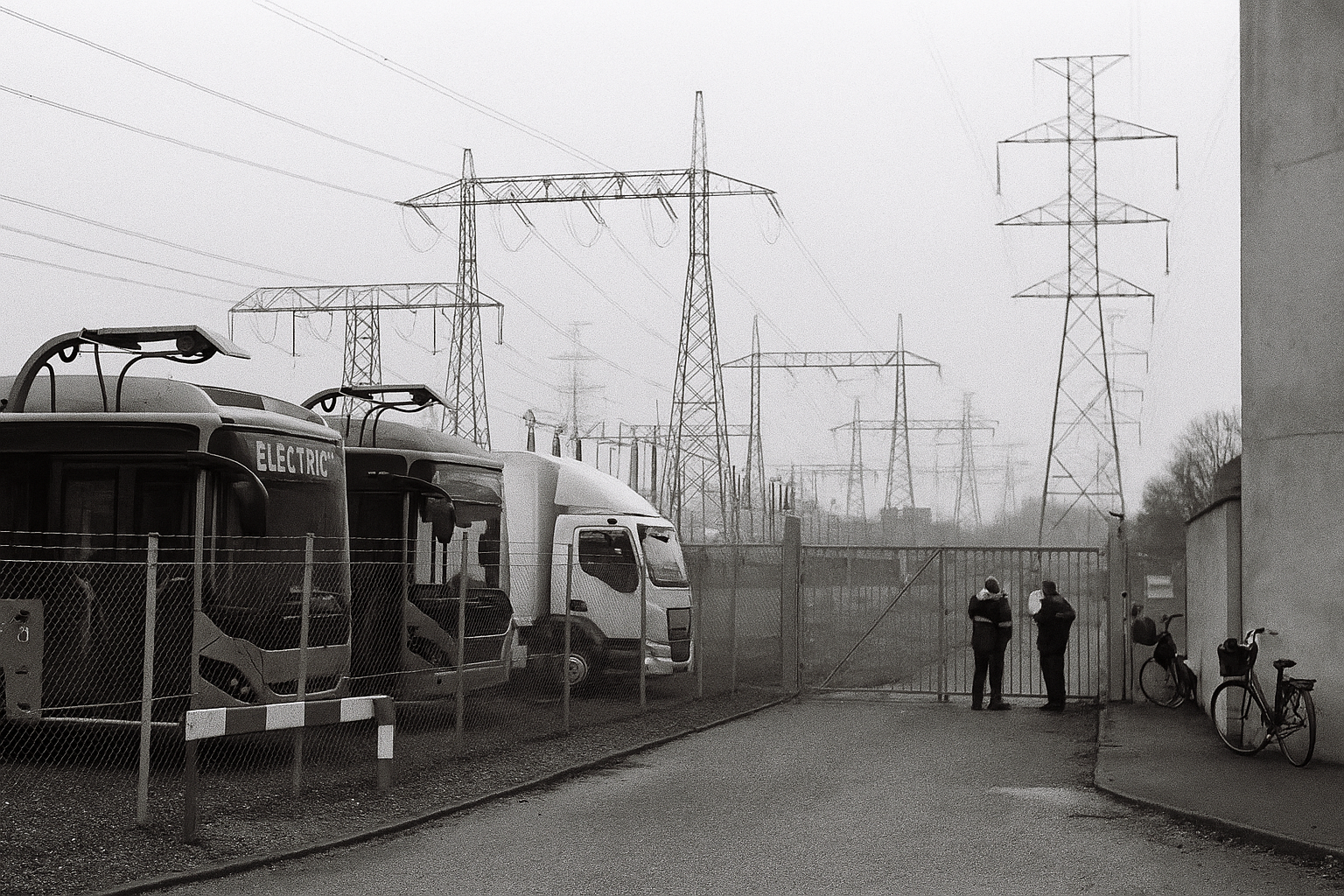
The image is less about futuristic energy systems than about ordinary hardware arriving too late: buses at depots, trucks at terminals and a cement company eyeing diesel generators because the green electricity queue is longer than the political timetable.
Källor: Jyllands-Posten