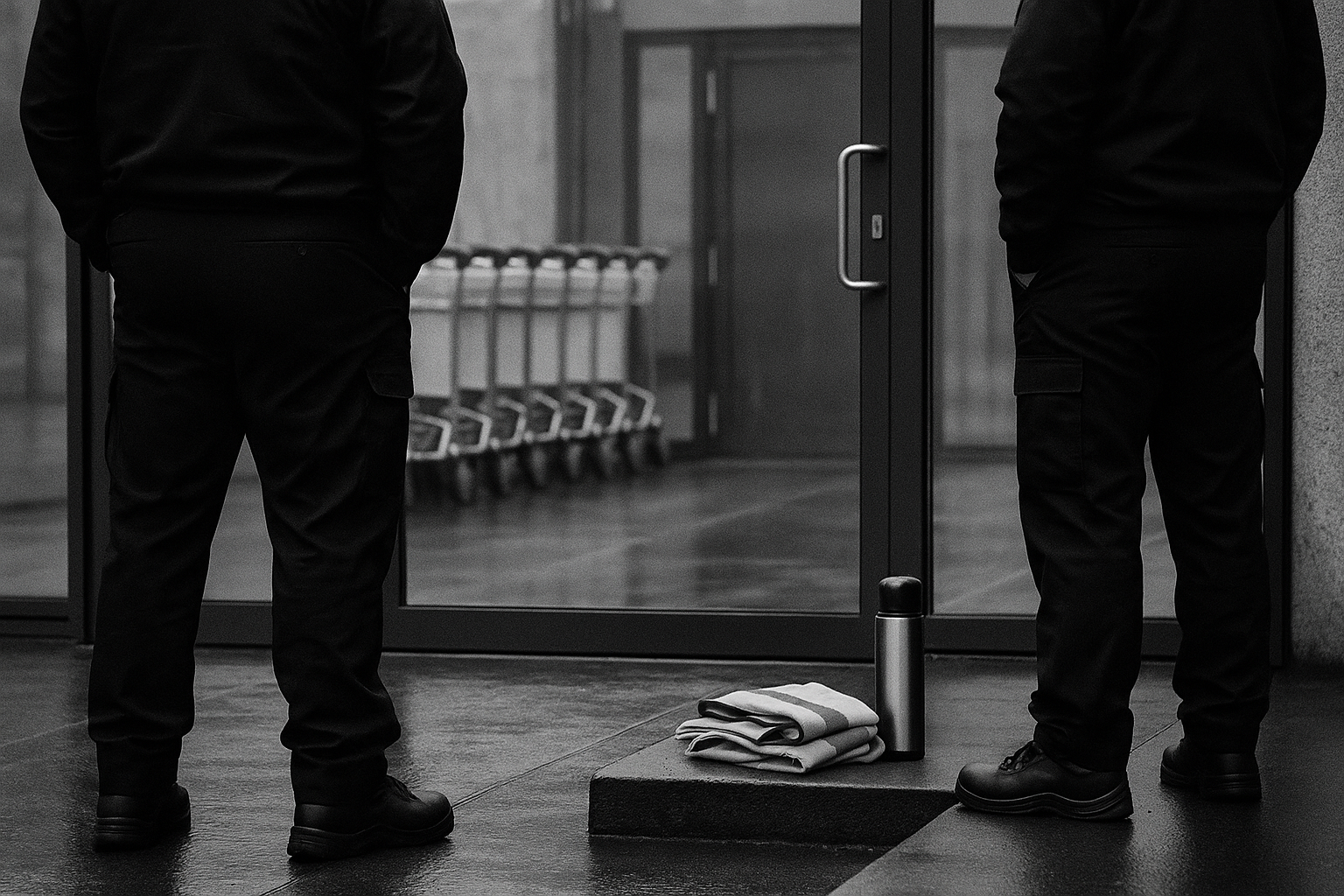
Guard strike averted, mediation spares airports and malls, narrow dispute shows service-sector choke points
- The dispute covered the security-guard agreement and ended in mediation before any strike began.
- A guard strike would have hit customer-facing sites such as transport hubs, shopping centres and other premises that depend on contracted security staff.
- The episode shows how a relatively limited private-sector dispute can spill quickly into daily public life.
- The agreement removes the immediate stoppage, but Norway’s bargaining model still leaves essential service functions exposed when outsourced work becomes a pressure point.
A planned strike by Norwegian security guards was stopped just before the deadline after mediation produced an agreement between NHO Service og Handel and the unions Norsk Arbeidsmandsforbund and Parat. Writing in VG, the newspaper reports that the parties reached a deal on the security-guard collective agreement after several overtime hours in mediation, meaning the guards will not walk out.
The immediate effect is simple: employers avoid disruption, workers get a revised settlement instead of a strike fund, and customers are spared the visible consequences that follow when contracted security staff disappear. Security guards sit at an awkward junction in the economy. They are employed in a private service business, but much of their work is performed in places the public treats as basic infrastructure: airports, transport nodes, shopping centres, office buildings, hospitals and events. When that labour is withdrawn, the dispute does not stay inside a payroll system. Doors close, queues lengthen, access is restricted and operators begin deciding which sites can stay open with fewer people on the floor.
That is the leverage point this mediation exposed. The security business is not large in the way manufacturing, oil or the public sector are large, but it occupies key access points. Employers therefore had more at stake than the line items in a wage settlement. A strike would have forced clients to improvise around contractual security requirements, insurance conditions and basic crowd-control needs. For workers, that same dependence is what gives a narrow occupational group bargaining power. A guard posted at an entrance or screening point can be harder to replace than his place in the wage hierarchy suggests.
The deal itself does not appear to alter the broader architecture of Norwegian wage bargaining. This was still the familiar sequence: negotiations fail, the National Mediator steps in, hours run past the deadline, and a settlement is reached before a stoppage begins. Norway’s model is built to produce exactly that outcome. But each such dispute also shows how much public-facing activity has been pushed onto private contractors whose employees can, for a few hours, hold a larger share of daily life than their numbers imply.
For now, the practical result is that the guards report to work as normal. The queues that did not form this morning are the clearest sign of what was being negotiated overnight.
Källor: VG