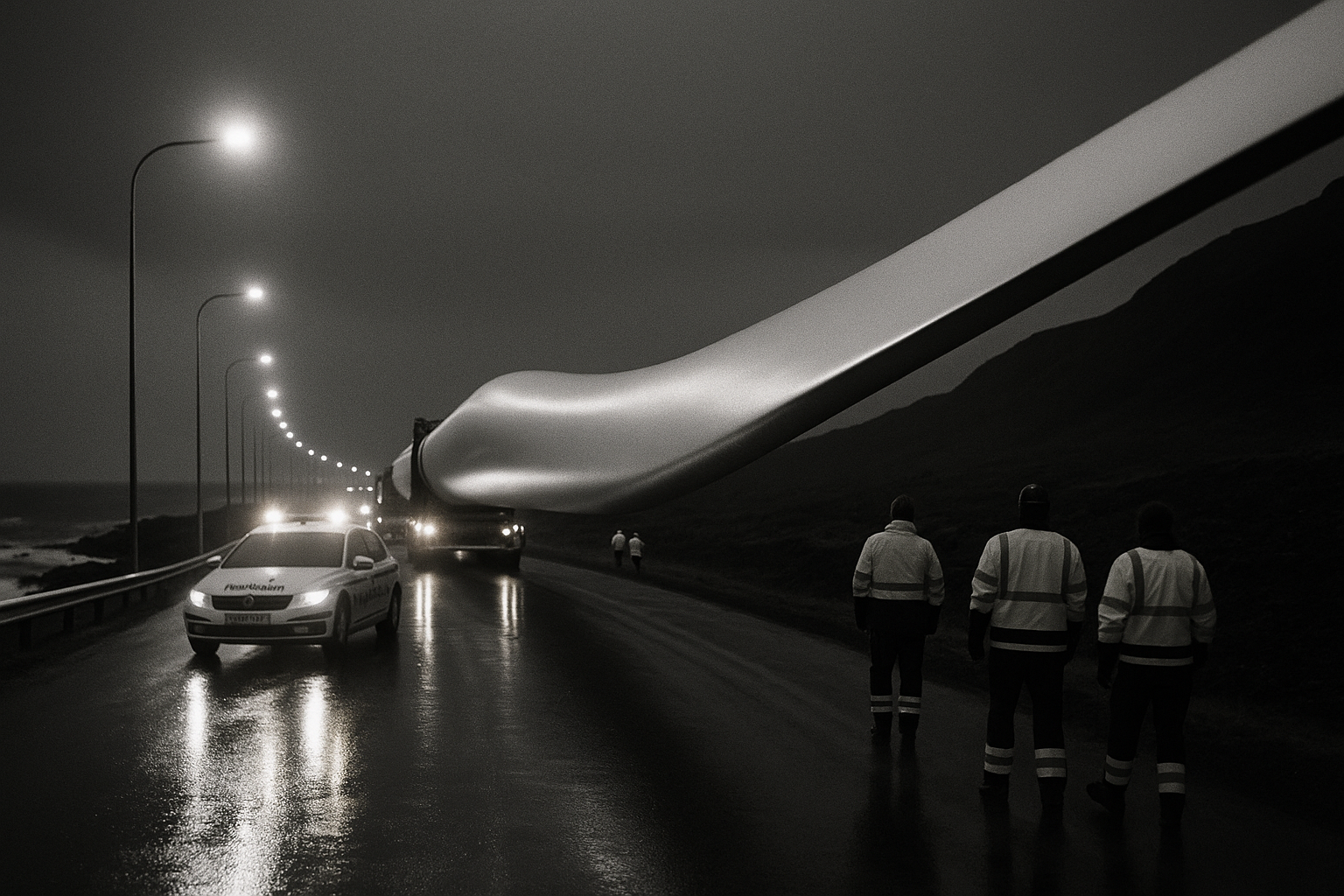
Heavy transport starts for Vaðölduver, 400 night convoys, road burden spreads across five municipalities
- RÚV reports that turbine transport will run six nights a week for the next 7 to 10 weeks.
- Each convoy can reach 250 metres in length and travels the 130-kilometre route at about 30 km/h.
- The route crosses Árborg, Ölfus, Flóahrepp, Ásahrepp and Rangárþing Ytra, with delays and short closures expected.
- Landsvirkjun plans to have half the turbines operating in autumn 2026 and the full wind farm completed by the end of that year.
Heavy transport for Vaðölduver began overnight from the port of Þorlákshöfn, sending the first turbine components for Iceland’s first wind farm onto a 130-kilometre route through southwest Iceland. RÚV reports that the convoys will run six nights a week for the next seven to ten weeks, crossing five municipalities before reaching the site where 28 turbines are due to be erected over the coming years.
The transport operation is large even by Icelandic heavy-haul standards. Each convoy can be up to 250 metres long, and the trips are expected to total roughly 350 to 400 journeys between Þorlákshöfn and Vaðölduver at around 30 kilometres per hour. The Icelandic Road and Coastal Administration, Vegagerðin, has warned of delays and short road closures while the moves are under way. That places the immediate cost of the project not at the turbine site but along the road network, where night traffic, escorting, temporary stoppages and wear from repeated oversize loads arrive months before any electricity does.
The route runs through Árborg, Ölfus, Flóahrepp, Ásahrepp and Rangárþing Ytra. For residents, that means repeated overnight convoys on local and regional roads for most of the summer. For the municipalities, it means coordination across multiple jurisdictions for a project owned by Landsvirkjun, the state power company, whose timetable extends beyond the transport phase: half the turbines are scheduled to be commissioned in autumn 2026, with the full wind farm meant to be in operation by the end of that year.
The sequence matters. Iceland’s power debate is usually framed around future supply, industrial demand and the need to diversify generation beyond hydro and geothermal. Vaðölduver shows the earlier stage of that policy. Before a new source of electricity reaches the grid, public roads become construction corridors, traffic is reorganised around a single industrial build, and local communities absorb the disruption on a schedule set elsewhere. The article from RÚV does not say who will ultimately cover any road damage or traffic-management costs beyond the transport operation itself. The convoys are moving anyway.
By the time the first blades are standing at Vaðölduver, hundreds of slow-moving loads will already have crossed five municipalities from the coast to the interior. The first output from Iceland’s first wind farm is still more than a year away; the first closures started this week.
Källor: RÚV