Helsinki keeps Kansalaistori crossing-free, traffic law collides with pedestrian design, cyclists absorb uncertainty
- The city says marked zebra crossings would restrict pedestrians because traffic law ties crossing rights to designated points.
- Kansalaistori is one of central Helsinki’s busiest public spaces, bordered by major cultural buildings and heavy foot traffic.
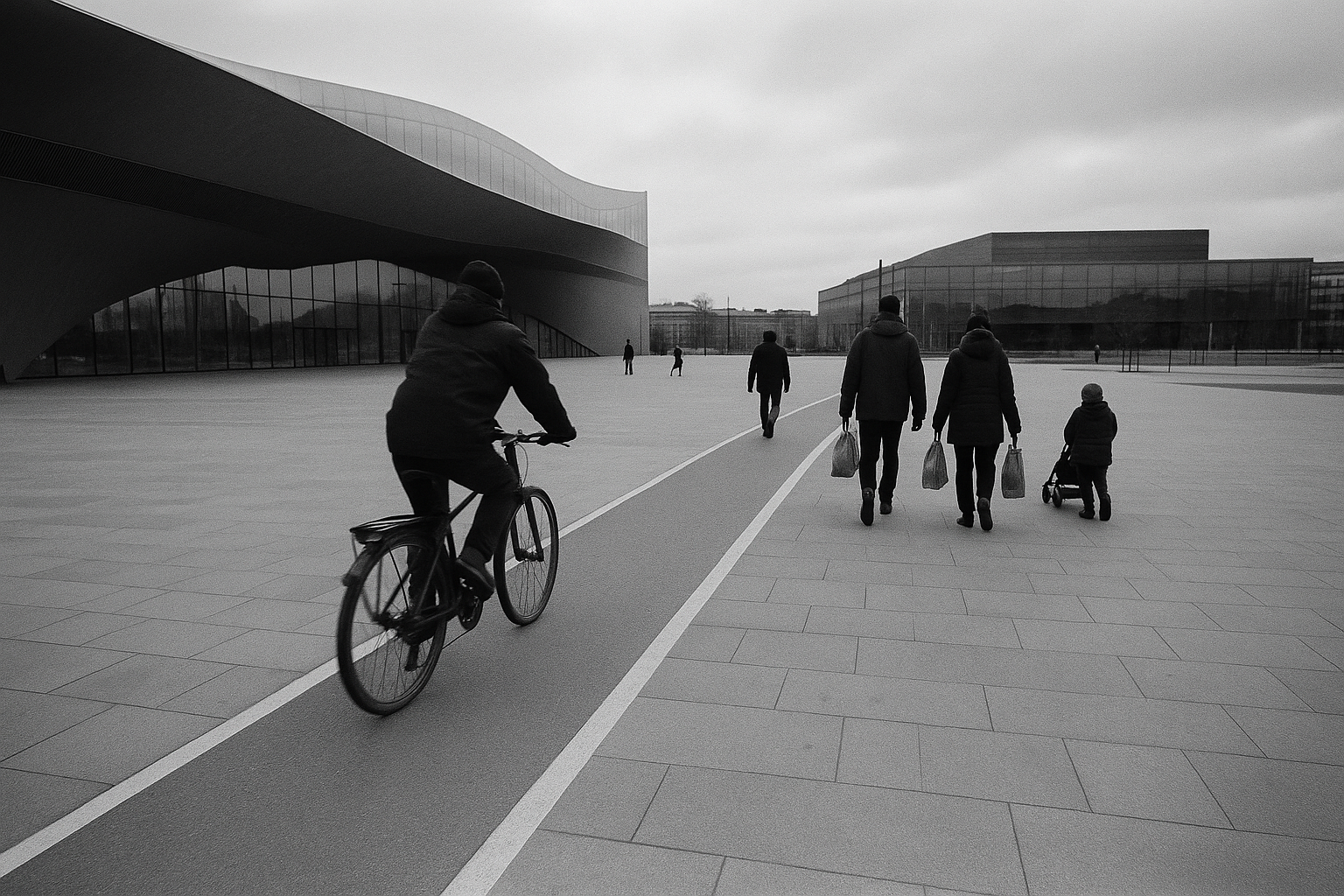
- The current layout leaves cyclists moving through a plaza where pedestrians can step across the lane at any point.
- The dispute shows how pedestrian-first planning can shift ambiguity and delay onto bike traffic rather than resolve movement conflicts.
Helsinki will not add zebra crossings to Kansalaistori, the large central square between Oodi, the Helsinki Music Centre and the Parliament area. According to Helsingin Sanomat, city officials argue that the square was planned so pedestrians may cross the bike lane wherever they choose, and that marking formal crossings would, under the Road Traffic Act, confine that right to specific places.
The argument is precise and revealing. A square built to dissolve boundaries between walking routes and public space now contains a bike corridor that still requires predictable rules if people are to move through it at speed. If pedestrians can enter the lane anywhere, cyclists are left reading body language rather than traffic control. The city preserves maximum discretion for walkers by withholding markings, but the cost is paid in uncertainty by those expected to cycle through one of the busiest civic spaces in the capital.
Kansalaistori is not a side street. It sits at the symbolic centre of Helsinki’s cultural quarter, drawing office workers, tourists, event crowds and library visitors across the same open surface throughout the day. In that setting, a design that works on an architect’s plan can become a negotiation repeated hundreds of times an hour: pedestrians drift across, cyclists slow or weave, and neither side gets the clarity that painted crossings or a more clearly separated route would provide.
The city’s legal reading also cuts in one direction. If zebra crossings would reduce pedestrian freedom because the law gives them force at designated points, that suggests the current arrangement depends on keeping the crossing legally vague. For pedestrians, that may feel generous. For cyclists, it means the route remains formally present but functionally subordinate to the square around it. A transport mode the city otherwise promotes is asked to yield not just at crossings, but almost everywhere.
Other Nordic capitals have reached for clearer separation in similar high-footfall areas: either bike traffic is slowed to near walking pace and treated as a guest in the square, or the cycle route is given sharper visual and spatial definition so pedestrians can see where through-traffic runs. Helsinki’s answer at Kansalaistori is to keep the bike lane and the plaza logic at the same time. That leaves the conflict in place and gives it a legal explanation.
The result is a central square where the pedestrians keep full latitude and cyclists carry the burden of anticipation. Outside Oodi, the lane remains marked enough to attract bike traffic, but not marked enough to tell thousands of people where crossing is supposed to happen.
Källor: Helsingin Sanomat