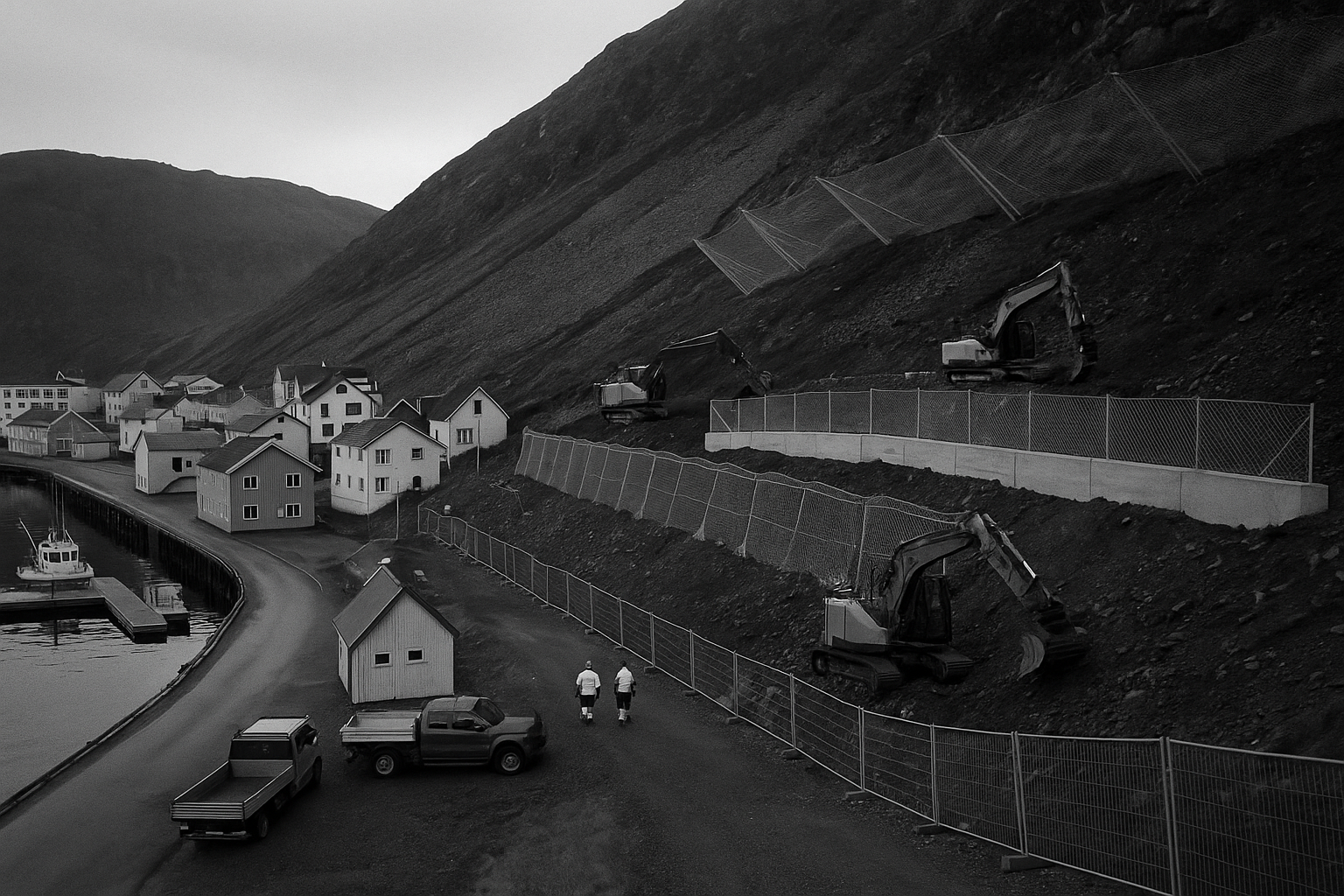
Honningsvåg fortifies against rockslides, Arctic tourist town turns mountain risk into public works bill
- The works are meant to protect homes and the town centre in Honningsvåg from rockfall and snow avalanches from Storfjellet.
- Residents living below the mountain told NRK the project improves sleep after years of living with the threat overhead.
- The case highlights a recurring public expense in exposed northern communities: hazard protection for places the market would struggle to insure or rebuild on its own.
Excavators and construction crews are now working below Storfjellet in Honningsvåg, where Norway is trying to reduce the chance that rockfall or snow avalanches will hit the town centre. NRK reports that the country’s northernmost town is being secured against future slides, a project residents say has immediate value in something less measurable than concrete: sleep.
Honningsvåg sits on Magerøya island in Finnmark, with steep ground rising directly behind parts of the settlement. That geography is also part of the town’s business model. The port is a gateway to North Cape, one of Norway’s best-known tourist destinations, and the dramatic terrain that draws visitors leaves houses, roads and commercial buildings exposed to the mountain above them. The state and local authorities are therefore paying not for scenery, but for the right to keep using land already built on.
According to NRK, the work is aimed at protecting central parts of Honningsvåg from both falling rock and snow slides from Storfjellet. For residents living under the slope, the risk has not been theoretical. The report describes a long-standing concern among those below the mountain, and the current works are presented as a way to avoid a future disaster rather than repair one after the fact. That choice has its own arithmetic: barriers, reinforcement and earthworks are expensive, but evacuation, demolition and rebuilding in a remote Arctic town are expensive too.
The question is larger than one place. Across northern Norway, small settlements were built where fishing, harbours and terrain allowed, not where modern risk models would have preferred. Once roads, utilities, schools and tourist businesses are in place, moving a town is harder than fortifying it. Public money then follows the mountain. A steep slope above a few streets can become a recurring budget item for municipalities and the state, especially in places where winter weather, freeze-thaw cycles and sparse alternative building land leave little margin.
That also sets the practical standard for what counts as acceptable risk. The goal is not to make Storfjellet harmless; mountains are not made safe in that sense. The goal is to lower the probability of a fatal event enough that people continue to live, trade and host visitors below it. In Honningsvåg, that means engineering works between the slope and the town, and an implicit decision that this settlement remains worth defending.
For locals, the trade-off is plain enough. They keep the harbour, the mountain backdrop and the tourist traffic, and they live with the fact that all three come attached to a protection bill. In Honningsvåg, the cliff still stands over the town; the difference is that Norway is now building something to stand in between.
Källor: NRK