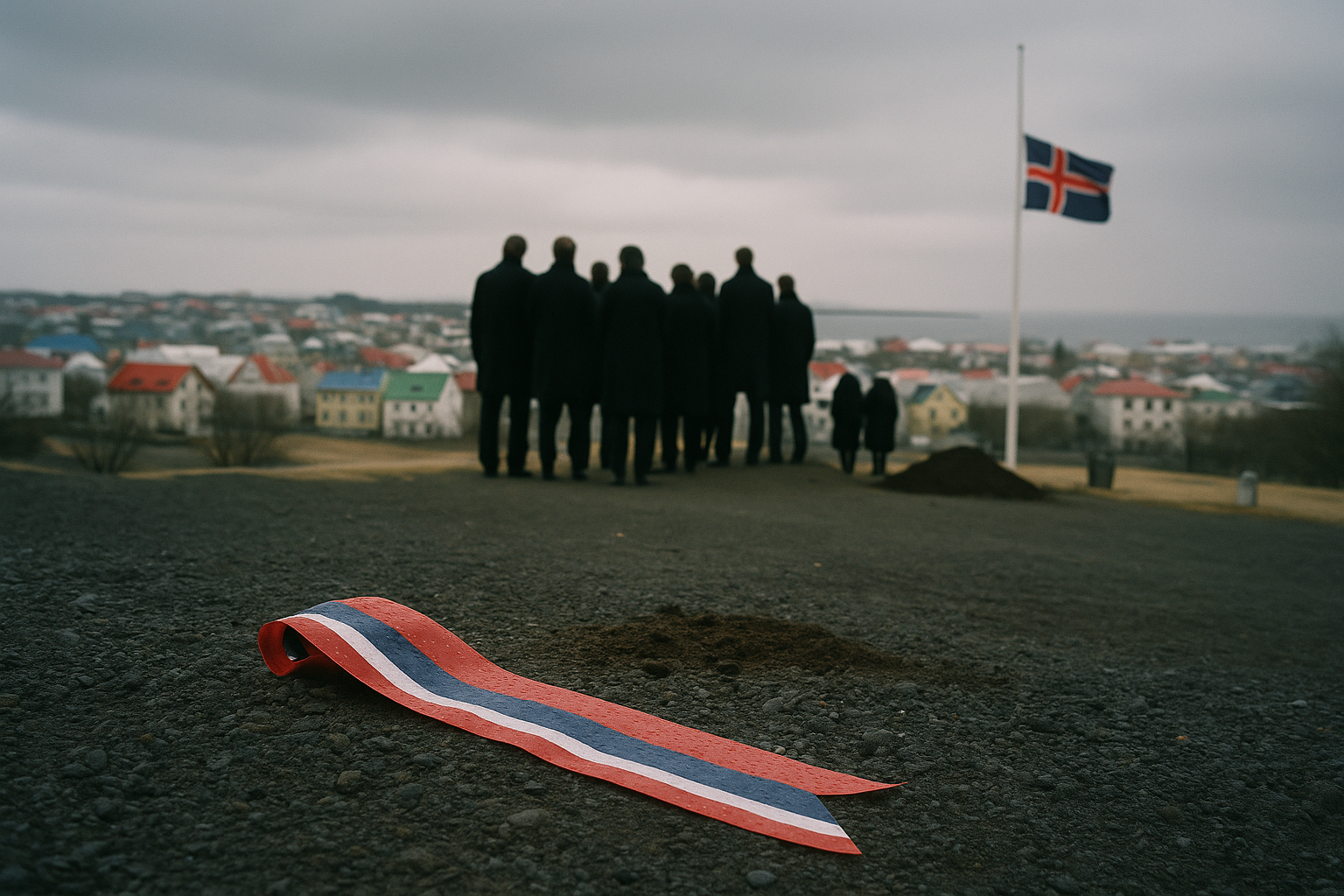
Iceland Buries Davíð Oddsson, Longest-Serving PM Who Privatised the Economy and Divided a Nation
- Oddsson served as Mayor of Reykjavík, Prime Minister (1991–2004), and Central Bank Governor before the 2008 crash
- His governments privatised state banks and deregulated the economy, transforming Iceland from a Nordic welfare state into a freewheeling financial hub
- The 2008 banking collapse, which wiped out an economy ten times Iceland's GDP, made Oddsson one of the most polarising figures in Icelandic history
- He later served as editor of Morgunblaðið, Iceland's paper of record, maintaining political influence until his death on March 1
Davíð Oddsson, the longest-serving prime minister in Icelandic history and the man who dismantled much of the country's state-run economy, is being buried today in Reykjavík. Morgunblaðið reports that Oddsson, who died on March 1, served as the newspaper's editor-in-chief in his final chapter — one more institution shaped by a figure who accumulated power across Icelandic public life like no one before or since.
Few Nordic politicians have held as many commanding positions in a single small country. Oddsson was Mayor of Reykjavík before becoming Prime Minister in 1991, a post he held for thirteen consecutive years. His Independence Party governments privatised the state-owned banks, slashed taxes, and opened Iceland's economy to foreign capital in ways that had no parallel in the Nordic region. For a decade, the results looked spectacular: GDP per capita soared, Reykjavík became a magnet for finance, and Icelandic entrepreneurs — the útrásarvíkingar, or "outvasion Vikings" — bought up assets across Europe with borrowed money. Oddsson moved from the prime minister's office to the governorship of the Seðlabanki Íslands (Central Bank of Iceland) in 2005, placing himself at the controls of the monetary system his own policies had unleashed.
Three years later, all three of Iceland's major banks collapsed in a single week. The combined debt was roughly ten times the country's annual economic output. Thousands of ordinary Icelanders lost savings. The króna cratered. Oddsson, still at the Central Bank, became the face of the catastrophe for his critics — the man who had privatised the banks, placed them in the hands of a small circle of businessmen with close political ties, and then failed to rein in the leverage that destroyed them. His defenders counter that the liberalisation created genuine wealth, that the banks were brought down by a global crisis, and that Iceland's rapid post-crash recovery vindicated the underlying economic reforms.
What is not disputed is the scale of the transformation. The Iceland Oddsson inherited in 1991 was a tightly regulated, state-dominated economy where the government controlled fishing quotas, bank lending, and broadcasting. The Iceland he left behind was unrecognisable — deregulated, financialised, globally connected, and scarred. He broke with the Nordic consensus that the state knows best, and the country lived with both the rewards and the wreckage.
After leaving the Central Bank under political pressure in 2009, Oddsson took the editor's chair at Morgunblaðið, Iceland's oldest and most influential newspaper, giving him a platform to shape public debate for another fifteen years. Mayor, prime minister, central bank governor, newspaper editor — in a country of 380,000 people, that sequence of positions represents a concentration of institutional power that would be remarkable anywhere and is almost without precedent in a democracy.
The mourners in Reykjavík today will include those who credit Oddsson with dragging Iceland into modernity and those who blame him for the worst economic disaster in the country's history. Both have evidence on their side. Iceland's banking system now holds assets worth roughly twice GDP — down from the ten-to-one ratio that preceded the crash, but still large for a microstate with its own currency and no lender of last resort.
Sources: Morgunblaðið