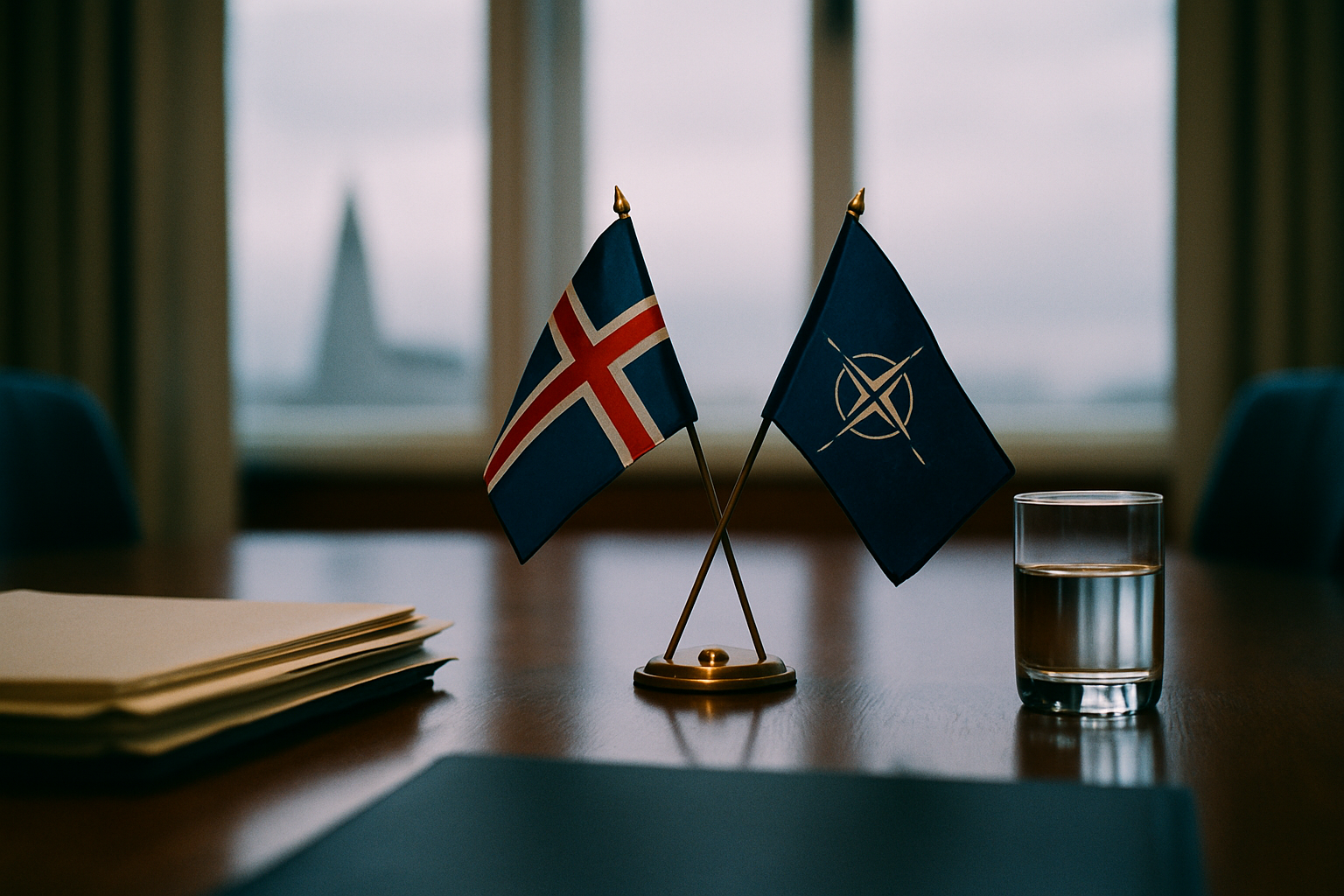
Iceland's foreign minister defends Greenlandic self-determination in Washington, frames NATO Arctic buildup as silver lining
- Gunnarsdóttir met the US deputy National Security Advisor, deputy Secretary of Defense, and members of both parties in Congress
- Iceland openly disagrees with US tariff policy while maintaining strong defence ties — a deliberate balancing act
- The minister framed increased Arctic and North Atlantic surveillance as a NATO initiative, not an American one
- Reykjavík expressed cautious optimism about the Denmark-Greenland-US working group but said the matter is far from settled
Iceland's Foreign Minister Þorgerður Katrín Gunnarsdóttir returned from Washington this week after delivering what she called a "principled position" on Greenland directly to the US deputy National Security Advisor and deputy Secretary of Defense, RÚV reports. In meetings that also included members of both Republican and Democratic congressional delegations and a deputy trade secretary, Gunnarsdóttir stressed Greenlandic self-determination and the inviolability of sovereign borders. She also raised Iceland's support for Ukraine — bundling two issues where Reykjavík's position diverges from the current mood in Washington into a single diplomatic trip.
The visit is a case study in how a country of 380,000 people navigates a relationship with the world's largest military power. Gunnarsdóttir was explicit that Iceland and the United States disagree on trade and tariffs, telling RÚV that Reykjavík stands firmly on the side of open markets and free trade. Yet she framed the security relationship as fundamentally intact, describing it as "good" regardless of what anyone else might say. The careful compartmentalisation — disagreement on economics, alignment on defence, outright opposition on Greenland's sovereignty — suggests Reykjavík has calculated that it can afford to be blunt precisely because the US needs Iceland's geography more than Iceland needs American goodwill.
The most calibrated part of the message concerned the Arctic military buildup. Rather than acknowledging American pressure on Greenland as the catalyst, Gunnarsdóttir credited NATO as the driving force behind increased surveillance in the North Atlantic and Arctic. "It is on NATO's terms that monitoring is increasing here," she said. The framing matters: it places the alliance, not Washington unilaterally, at the centre of Arctic security — a distinction that protects Nordic sovereignty claims and keeps the discussion multilateral. For a country that hosts the Keflavík air base and sits astride the GIUK gap, the question of who controls Arctic security architecture is existential, not academic.
Iceland has no army, no nuclear deterrent, and a GDP smaller than that of a mid-sized European city. Its leverage in the Greenland dispute is almost entirely positional — geographic and diplomatic. Reykjavík's willingness to state its position publicly in Washington, rather than through quiet channels, signals that this is as much about Nordic solidarity as it is about bilateral relations. Denmark and Greenland are negotiating with the US through a trilateral working group that Gunnarsdóttir described with guarded optimism, noting the matter is "not necessarily finished" but expressing hope for a good outcome. Iceland is not at that table. By making its stance public, it ensures its voice is in the room anyway.
The broader Nordic response to American pressure on Greenland has been cautious to the point of near-silence from Stockholm, Helsinki, and Oslo. Reykjavík's decision to raise the issue directly with senior Pentagon and National Security Council officials — and then talk about it on the record — stands out. Whether this reflects genuine strategic confidence or the diplomatic equivalent of a small dog barking loudly is an open question. What is not open to question is the geography: any change in Greenland's status reshapes the security environment for every country in the North Atlantic, and Iceland sits closer to Greenland than any other NATO member except Denmark itself.
Gunnarsdóttir told RÚV the long friendship between Iceland and the US must be maintained even when the two countries disagree. She then flew home to a country currently subject to American tariffs that her government considers unjustified.
Sources: RÚV