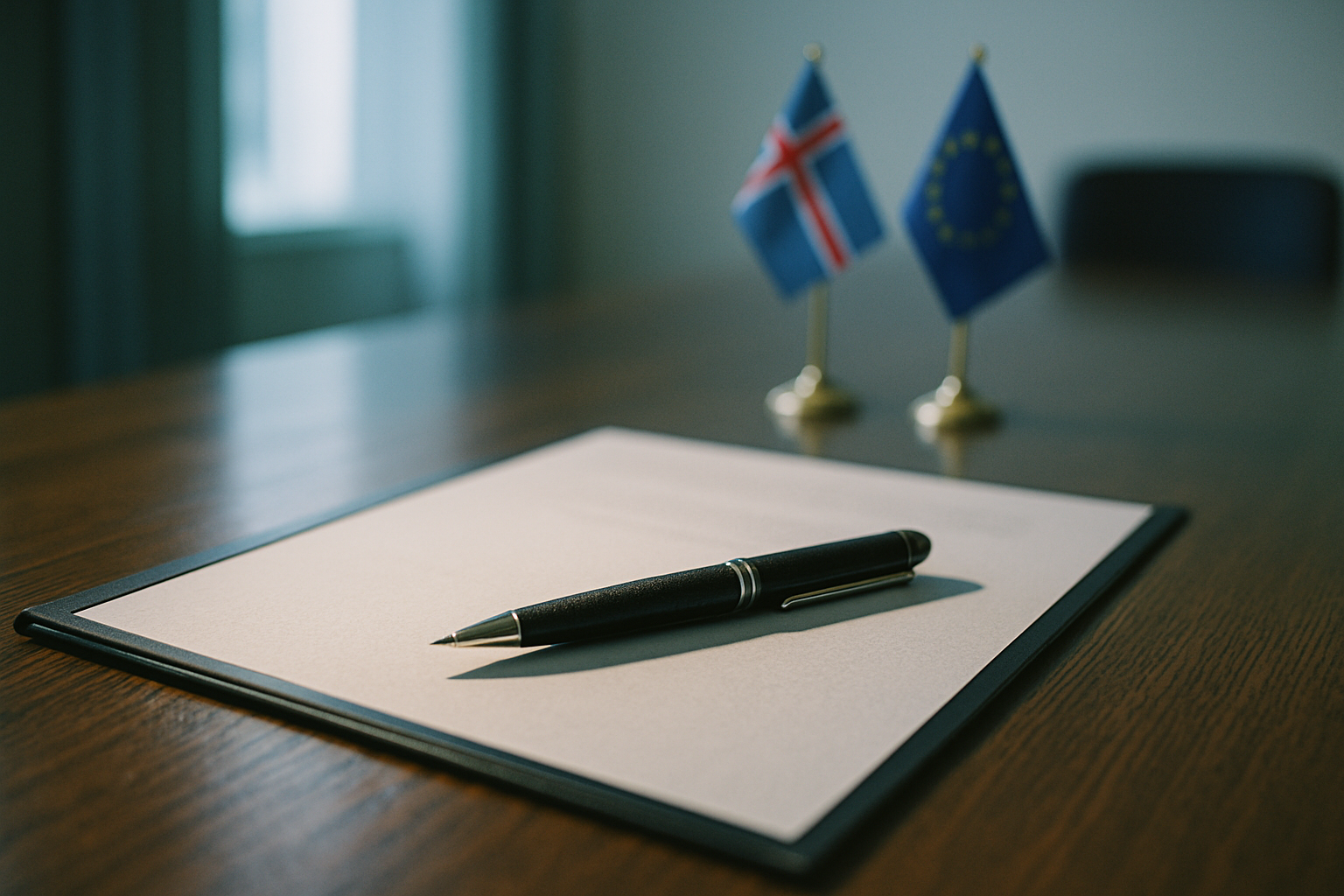
Iceland Signs EU Defence Pact, Country Without Army Deepens Brussels Security Ties
- Foreign Minister Þorgerður Katrín Gunnarsdóttir signed the declaration with EU foreign policy chief Kaja Kallas
- Iceland joins Norway, Canada, the UK, and six other non-EU states that have already signed similar agreements
- The signing coincided with meetings at NATO headquarters and with the EU commissioner overseeing EEA relations
- Iceland has no standing army, making its defence alignment choices uniquely consequential among NATO members
Iceland's Foreign Minister Þorgerður Katrín Gunnarsdóttir and EU foreign policy chief Kaja Kallas signed a declaration on defence and security cooperation in Brussels on Tuesday, RÚV reports. Iceland becomes the tenth non-EU state to formalise such an arrangement, following Norway, Canada, the United Kingdom, and six others. For NATO's only member without a standing army, the agreement carries weight that similar declarations signed by militarily self-sufficient states do not.
Gunnarsdóttir's Brussels itinerary told its own story. Her first meeting of the day was at NATO headquarters, where Deputy Secretary General Radmila Shekerinska received her. The EU defence signing followed. She then sat down with Maroš Šefčovič, the European Commissioner responsible for relations with the EEA states — Iceland, Norway, and Liechtenstein. Three meetings, three institutional frameworks, all in a single day: a compressed tour of the overlapping alliance structures that now define European security.
Kallas framed the declaration in terms of necessity. "Uncertain times in international affairs call for increased cooperation among friendly states," she told the European Parliament the day before the signing. The language is diplomatic boilerplate, but the context is not. The EU's emerging defence architecture — accelerated by the war in Ukraine and growing doubts about American reliability — is pulling non-EU states into its orbit whether they sought membership or not. Norway signed its version earlier. For Oslo, a country with a capable military and a long land border with Russia, the calculus is straightforward enough: hedge against Washington by building a parallel relationship with Brussels.
Iceland's position is more exposed. The country abolished its US-run military base at Keflavík in 2006, relies on NATO's collective defence guarantee for its territorial security, and has no troops to contribute to any framework it joins. What it does have is the most strategically valuable piece of real estate in the North Atlantic — the mid-ocean position that controls the GIUK gap, the chokepoint between Greenland, Iceland, and the UK through which Russian submarines must pass to reach the open Atlantic. Every defence partner Iceland signs up with is, in practice, buying access to that geography.
The EU accession question hangs over everything. Iceland applied for membership in 2009, froze the process in 2013, and has never formally withdrawn the application. Defence cooperation with Brussels — even short of membership — reopens that wound in Icelandic politics. The current government frames these agreements as practical necessity rather than a step toward accession. Whether Brussels sees it the same way is another matter.
Norway's parallel path offers a useful comparison. Oslo has managed to deepen EU defence ties while keeping the accession question firmly off the table, helped by the fact that Norwegian voters rejected EU membership twice and the political class has no appetite for a third attempt. Iceland's situation is messier: the application still technically exists, and every new institutional link to Brussels gives ammunition to both sides of the debate.
What none of this addresses is the deeper question: why a country of 380,000 people needs to navigate three separate Western security architectures — NATO, the EU's defence framework, and the EEA — to secure its own waters. A Nordic defence union built around the region's shared geography and mutual interests would give Iceland a framework where its strategic position is an asset rather than a bargaining chip. Instead, Reykjavík adds another signature to another declaration in another capital that is not Scandinavian.
Sources: RÚV