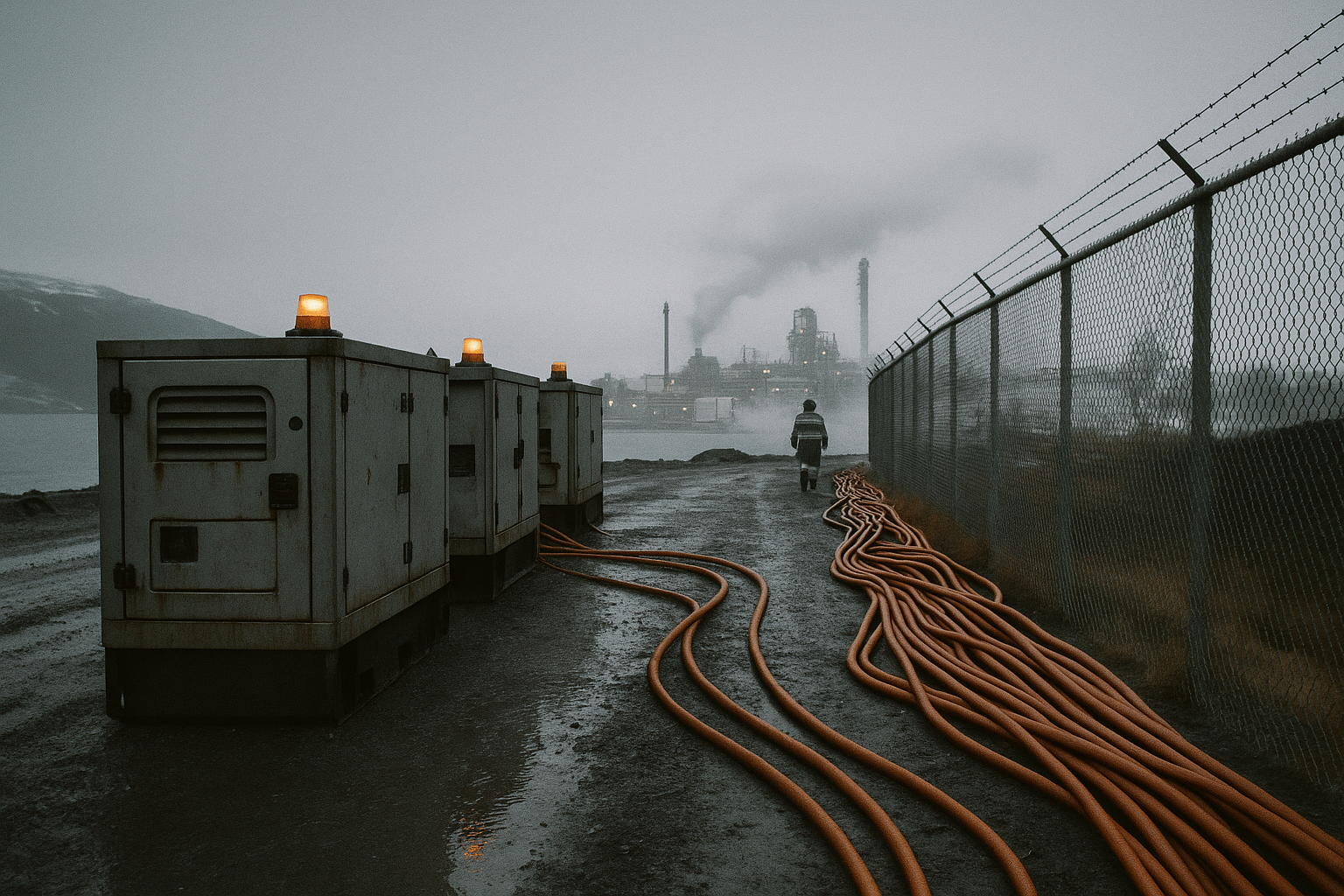
Melkøya gas plant stays on table, Northern Norway power squeeze hits electrification plans, diesel enters government options
- Energy Minister Terje Aasland told Nettavisen the government is considering continued operation of Melkøya’s gas plant because of the power situation in Northern Norway.
- Diesel generators are also being examined, underscoring how tight supply has become around one of Norway’s flagship electrification projects.
- The dispute reaches beyond Melkøya: new industrial demand, weak grid capacity and delayed power additions are colliding in the north.
- The central question is who absorbs the bottleneck cost — households through higher prices, industry through delays, or the state through subsidies and grid spending.
Norway’s government is now openly weighing a longer life for the polluting gas-fired plant at Melkøya, and even diesel generators, because Northern Norway does not have enough power to absorb planned electrification. In Nettavisen’s reporting, Energy Minister Terje Aasland says the strained power situation in the north has put both options on the table.
That matters beyond Hammerfest. Melkøya, the island facility where gas from the Snøhvit field is processed and exported as LNG, has become a test case for Norway’s energy policy: cut emissions at an existing industrial site by replacing on-site gas power with grid electricity, while the region already struggles with limited capacity and competing demand. Once the available power is not there, the arithmetic changes. The government can still promise lower emissions on paper, but only by delaying other consumption, building more grid, or keeping backup generation that burns fuel anyway.
The costs do not disappear; they move. If scarce power is reserved for large industrial projects, households and smaller businesses in Northern Norway face a tighter market and weaker room for new connections. If the state steps in with subsidies, accelerated grid investment or special arrangements for industry, taxpayers absorb part of the bill. If projects are postponed, companies carry the delay while ministers defend targets set before the transmission lines and generation were in place.
Melkøya has already exposed the sequence problem in the transition: electrification first, power later. Northern Norway has seen rising interest from energy-hungry industry, data centres and new processing projects, while grid expansion moves at the speed of permits, local opposition and construction seasons above the Arctic Circle. Against that backdrop, a diesel generator stops looking like an aberration and starts looking like what it is: an expensive bridge over a gap the system has not closed.
The political cost is also becoming harder to hide. For years, electrification has been sold as a cleaner substitute for direct combustion at industrial sites. At Melkøya, the government is now discussing whether the cleaner substitute must be backed by a gas plant that was meant to go, or by diesel engines brought in because the grid cannot carry the load. The problem is no longer whether the ambition sounds right. The problem is whether the wires, generation and timing exist at the same time.
That question reaches across the Nordic region. Many industrial decarbonisation plans assume abundant low-carbon electricity, but the queue for that power is already longer than the supply in several places. On Melkøya, the green shift is currently being negotiated with a gas turbine and a diesel tank nearby.
Källor: Nettavisen