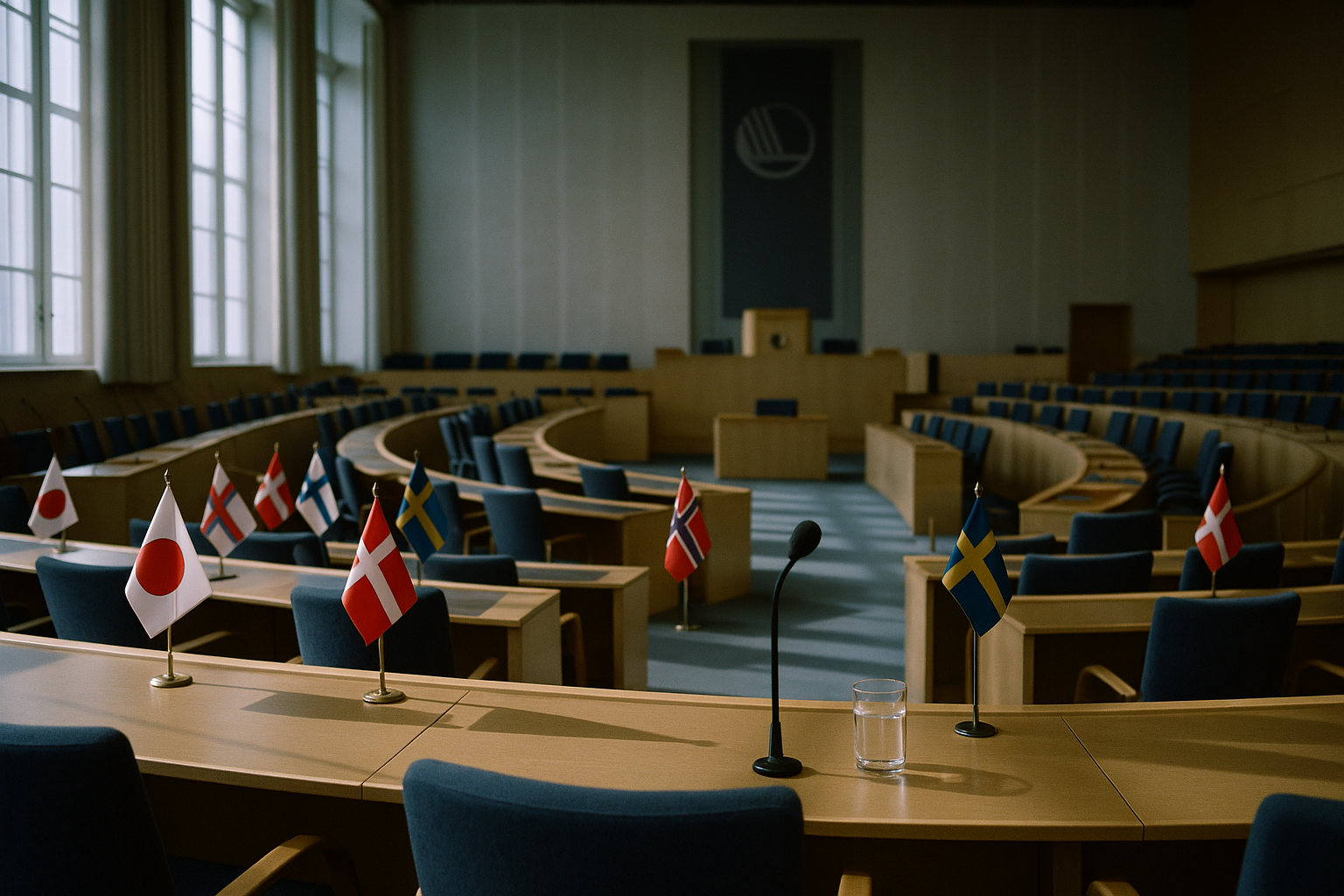
Nordic Council Examines Full Membership for Greenland, Faroes, and Åland, Testing Region's Commitment to Unity
- All three self-governing territories currently hold limited voting rights and reduced influence within Nordic cooperation bodies
- The commission's work comes as Greenland's geopolitical significance has surged due to US interest in the island
- Upgrading the territories' status would reshape the institutional architecture of the Nordic Council, potentially creating an eight-member bloc
- The question tests whether Nordic cooperation is a club of sovereign states or a genuine regional framework for all Nordic peoples
A commission under the Nordic Council has been tasked with examining whether Greenland, the Faroe Islands, and Åland should be elevated from their current second-tier positions to full and equal participants in Nordic cooperation, DR Nyheder reports. The three self-governing territories — Greenland and the Faroes under the Danish realm, Åland under Finnish sovereignty — have long held seats in Nordic institutions but with restricted voting rights and limited influence over decisions that directly affect them. The commission's findings could fundamentally alter the power structure of the region's oldest multilateral body.
The timing is anything but accidental. Greenland has become the subject of sustained American interest, with Washington making barely veiled claims on the island's strategic and mineral resources. In that context, the question of how Greenland is treated within Nordic structures carries weight far beyond parliamentary procedure. A Greenland that feels sidelined in its own regional neighbourhood is a Greenland more susceptible to outside courtship. Giving Nuuk a genuine voice in Nordic decision-making would be the most concrete signal the region could send — both to Greenlandic voters and to external powers — that the Nordic countries regard the island as an integral part of their political community, not a Danish dependency to be managed.
The same logic applies, with different strategic overtones, to the Faroe Islands and Åland. The Faroes control some of the North Atlantic's most productive fishing waters and sit astride critical sea lanes. Åland, demilitarised by international treaty since 1856, occupies a strategically sensitive position between Sweden and Finland in the Baltic Sea. Both territories have developed increasingly distinct political identities and have, at various points, chafed at being represented through their parent states in forums where their specific interests diverge from Copenhagen's or Helsinki's.
The structural problem is straightforward. The Nordic Council — founded in 1952 as a parliamentary body for Denmark, Iceland, Norway, and Sweden, later joined by Finland — was designed as a forum for sovereign states. The self-governing territories were added as associated members, a category that gave them presence without power. They can participate in debates but lack full voting rights on all matters. In a body that operates largely by consensus, this distinction might seem academic. But consensus is shaped by who sits at the table with a full voice, and the territories have consistently found themselves consulted rather than included.
Upgrading three territories to equal standing would create, in effect, an eight-member Nordic bloc — five sovereign states and three self-governing territories with full participatory rights. Critics will argue this conflates sovereignty with autonomy, giving sub-national entities the same institutional weight as independent countries. Proponents counter that Nordic cooperation was never meant to be a miniature United Nations; it was meant to bind together peoples with shared history, language, and interests. By that measure, Greenland's 57,000 Inuit inhabitants and the Faroes' 54,000 residents have as much claim to a seat as Iceland's 380,000.
The commission has not yet set a timeline for its conclusions. What it produces will reveal whether the Nordic countries are prepared to match their rhetoric about regional unity with institutional reform — or whether the self-governing territories will remain, as they have for seven decades, members of the family who eat at the children's table.
Sources: DR Nyheder