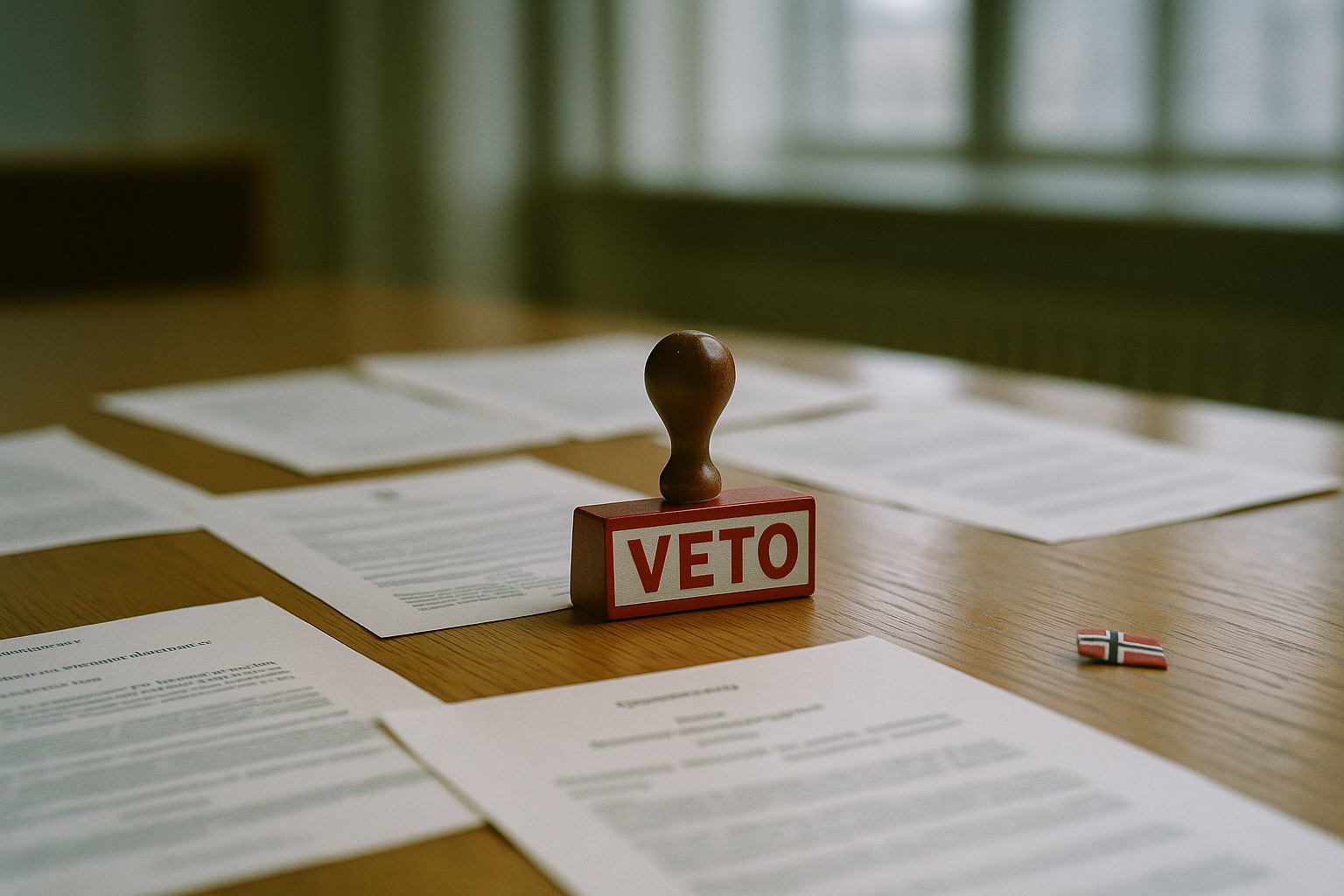
Norway Edges Toward First-Ever EEA Veto, EU Network Fee Proposal Unites All Parties in Opposition
- The EU's 'network package' would force large content providers like Netflix and Google to pay telecom companies for infrastructure use — a model Norwegian operators and politicians say would undermine the country's broadband success
- Norway's EEA veto has existed since 1994 but has never been exercised, despite Norway adopting thousands of EU directives as the price of single-market access
- All major Norwegian political parties and the telecom industry oppose the proposal, making it the strongest candidate for a veto in EEA history
- Whether Oslo actually pulls the trigger will test whether the veto is a real sovereignty tool or a constitutional ornament
Norway's EEA Agreement contains a veto right that has existed, untouched, since the deal took effect in 1994. Across three decades and thousands of adopted EU directives, no Norwegian government has ever invoked it. That may be about to change. Nettavisen reports that a new EU proposal — the so-called network package — has produced something rare in Norwegian politics: total unity in opposition.
The EU proposal would require large internet content providers — companies like Google, Netflix, and Meta — to pay telecom operators for the broadband infrastructure their services rely on. The logic from Brussels is that tech giants generate enormous traffic volumes while telecom companies bear the cost of building and maintaining the networks. European telecom lobbies have pushed the idea for years. But the model cuts directly against how Norway built one of the world's best broadband networks: through competition, light regulation, and a market structure where operators invest because they profit from growing demand, not because regulators force content companies to subsidise them.
Norwegian telecom operators oppose the proposal. So does the industry association. So does every major political party in the Storting (Norwegian parliament), from the governing Labour Party to the opposition Conservatives, the Progress Party, and the Socialist Left. The breadth of opposition is striking in a country where EU-related policy typically splits along familiar lines — with the left more sceptical and the right more accommodating. On this issue, there is no daylight between them. The concern is both practical and principled: the fee model could distort investment incentives, create regulatory complexity, and import a framework designed for underperforming European telecom markets into a Norwegian market that already delivers high speeds and wide coverage.
The political consensus makes the network package the strongest veto candidate in EEA history. But whether Oslo will actually use the mechanism is a separate question. Norway's relationship with the EU is built on a quiet bargain: reject formal membership, accept nearly all the rules anyway, and maintain the fiction of sovereignty through a veto that never gets used. Invoking it would set a precedent. Brussels would not take it lightly — the EEA Agreement includes provisions allowing the EU to suspend parts of the single-market access that Norway depends on for its non-oil exports. Every previous Norwegian government has calculated that the cost of confrontation exceeds the cost of compliance. The veto has functioned not as a tool of sovereignty but as a pressure valve that lets politicians tell voters the option exists, without ever testing what happens when it's turned.
The network package may be the issue where that calculation finally tips. The proposal is still working its way through EU institutions and could be modified before reaching the EEA. Norwegian officials have time to lobby for changes. But if the directive arrives in its current form, the Storting will face a question it has avoided for thirty years: whether the veto right written into Norway's most important international agreement is a real instrument of self-governance or an ornament.
Norway has adopted over 13,000 EU legal acts through the EEA. The veto counter remains at zero.
Sources: Nettavisen