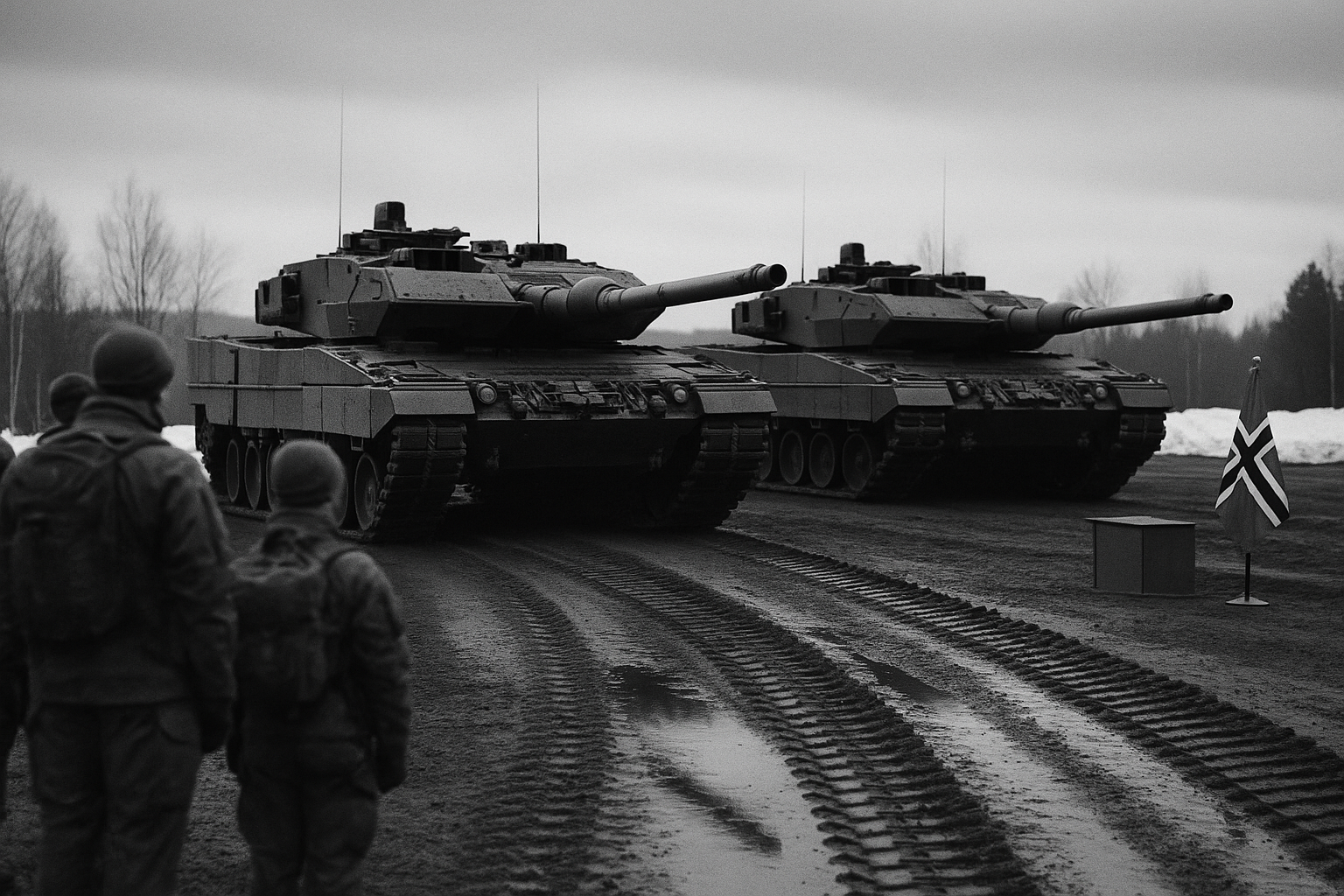
Norway receives first Leopard tanks, Rena ceremony marks delayed army rebuild
- Two Leopard 2A8 tanks were presented at Rena, the Norwegian Army’s main base for armored forces.
- The tanks are the first visible step in Norway’s plan to replace aging Leopard 2A4 vehicles.
- Deliveries will continue over several years, leaving a gap between procurement decisions and fielded combat power.
- Training, maintenance, logistics and supporting units will determine whether the purchase becomes real readiness.
Two new Leopard 2A8 tanks rolled into Rena on Thursday, the first delivered under Norway’s long-awaited tank purchase. VG reports that the vehicles were formally presented at the Østerdal Garrison, home to much of the Norwegian Army’s armored capability. For an army that has spent years discussing modernization more than displaying it, the image was unusually concrete.
The procurement is meant to replace Norway’s elderly Leopard 2A4 fleet, vehicles bought second-hand from the Netherlands in the 2000s and upgraded in stages while larger decisions were postponed. The new tanks give the army a more modern platform, but two vehicles at a ceremony are not yet an armored force. A tank battalion needs trained crews, repair capacity, spare parts, recovery vehicles, engineers, air defence, ammunition stockpiles and enough hulls on hand that breakdowns and training losses do not hollow out the unit before it reaches the field.
That is where the timetable matters. Deliveries spread over years smooth the budget, but they also stretch the period in which old and new systems must coexist. Crews must be retrained, technicians qualified, simulators installed and doctrine adjusted to the new platform’s sensors, protection and fire-control systems. Every month between first delivery and operational mass is a month in which Norway can point to a procurement success while still relying on a thin force structure and allied reinforcement for depth.
Rena is the right place to stage the handover because it shows where the tanks are supposed to live: not in procurement documents, but in line units. Yet the army’s wider gaps remain visible. Heavy armor is only one part of land warfare in the High North. Long-range fires, ground-based air defence, engineering support, ammunition reserves and sustainment capacity decide how long armored units can fight once the photographs are over. Norway has money, modern equipment on order and a more serious security climate than it had a decade ago; what it has lacked is speed.
The arrival of the first two tanks therefore says less about completed rearmament than about movement after a long pause. The old pattern was delay, life-extension and dependence on allied backup. On Thursday at Rena, the army could finally put steel in front of cameras. Two tanks stood on the parade ground; the rest of the force is still on the delivery schedule.
Källor: VG