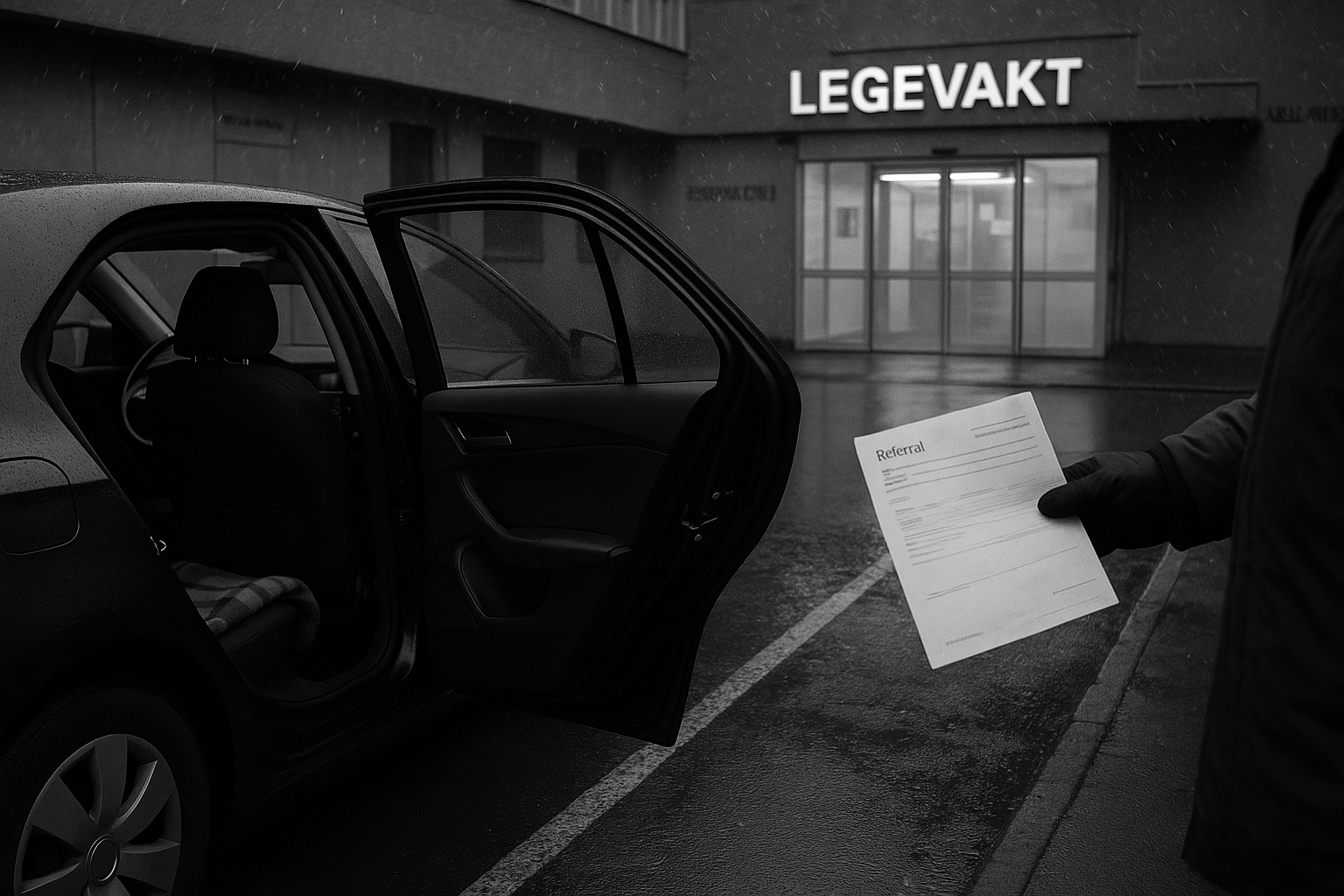
Norwegian legevakt sent critical patient by taxi, watchdog faults triage, ambulance was never called
- The doctor considered the case potentially life-threatening and said admission was urgent.
- The patient was still sent by taxi rather than ambulance, according to Nettavisen.
- Statsforvalteren concluded the legevakt breached its duty to provide sound healthcare.
- The case points to pressure points in Norway’s out-of-hours emergency chain, where transport choice can become part of triage.
A Norwegian legevakt, the municipal out-of-hours emergency clinic, sent a seriously ill patient to hospital by taxi even after a doctor had assessed the condition as potentially life-threatening and in need of urgent admission. Nettavisen reports that the Statsforvalteren, the state administrator and supervisory authority, has delivered a sharply worded ruling on the case and concluded that the clinic’s handling was not medically sound.
According to Nettavisen’s account of the ruling, the doctor understood that the patient’s condition could be serious enough to threaten life. The patient nonetheless was not transported by ambulance. Instead, the legevakt chose a taxi, a decision the watchdog says exposed the patient to unacceptable risk. The point in dispute is not whether the patient needed hospital care; the doctor had already decided that admission had to happen quickly. The dispute is what the service did after reaching that conclusion.
That distinction matters because transport is part of treatment in acute care, not an administrative afterthought. An ambulance brings monitoring, trained personnel and the ability to intervene if a patient deteriorates on the road. A taxi brings a seat and a meter. When a clinic has already identified a potentially life-threatening condition, the gap between those two options is hard to explain away as a minor judgment call.
Norway’s legevakt system sits between general practice and hospital emergency departments and is designed to absorb large volumes outside normal office hours. That gives frontline services strong incentives to sort, defer and move patients onward efficiently. Most of the time that means routine prioritisation. In the cases that go wrong, the pressure shows up in small operational choices: who gets observed, who gets sent home, who gets an ambulance, and who is told to find another way. The Statsforvalteren’s ruling suggests this was one of those moments when the system had already recognised danger but still handled the patient as if transport were a logistical detail.
Nettavisen’s report does not present the case as a debate over hindsight. The doctor’s own assessment established the seriousness before the patient left. That leaves narrower questions: what exactly the staff believed an ambulance was for, who made the final transport decision, and whether local routines treat ambulance use as something to be rationed even after severe risk has been identified. Supervisory cases of this kind rarely arise from one bad minute alone; they usually reveal what a service considers normal until an external authority writes it down.
For patients, the practical dividing line is simple enough. If the service says the condition may be life-threatening and hospitalisation is urgent, the journey itself becomes part of emergency care. In this case, the vehicle that arrived was a taxi.
Källor: Nettavisen