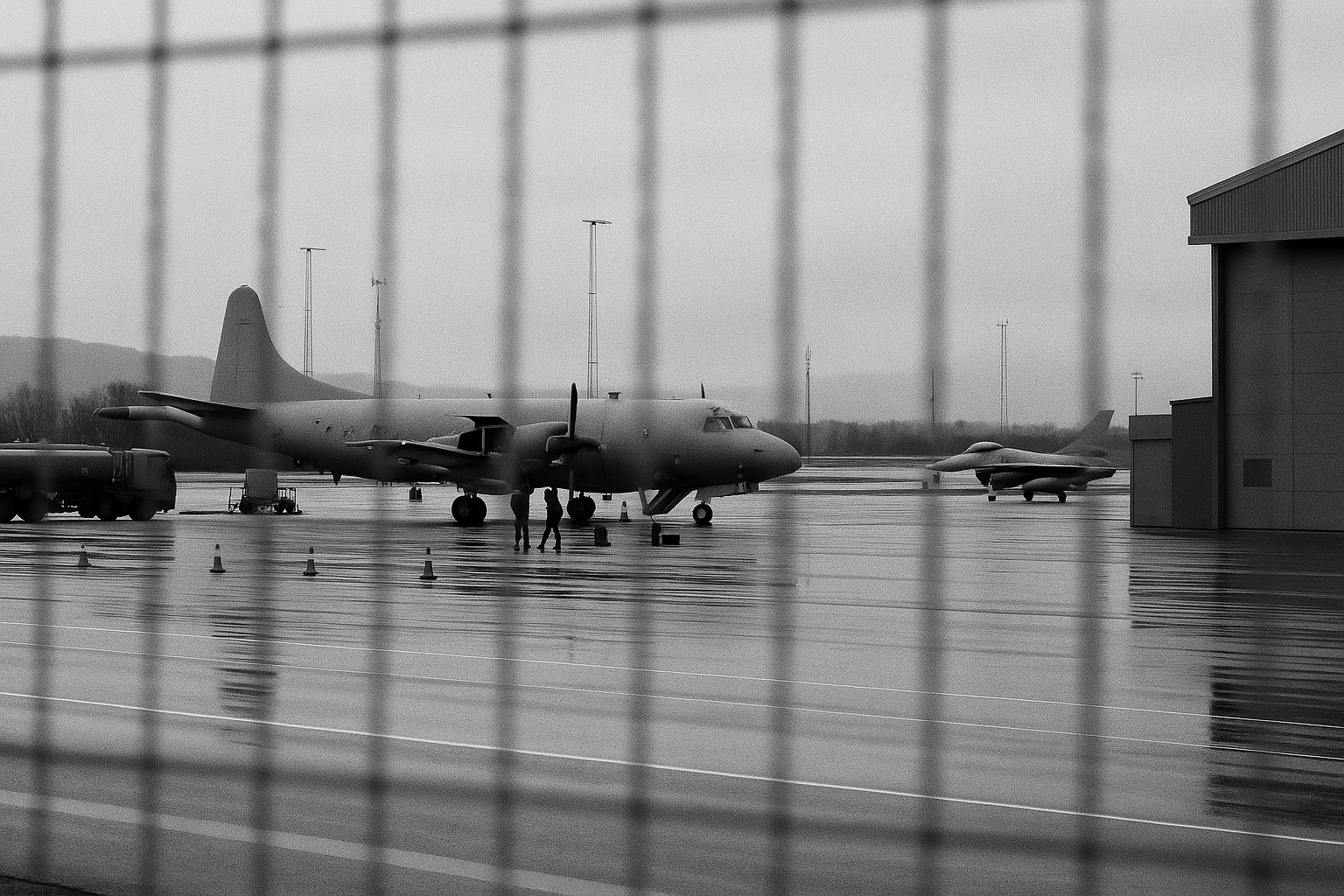
Norwegian surveillance aircraft makes emergency landing, Evenes concentrates northern defence load, one air base carries several missions
- Dagbladet reports that a Norwegian aircraft used for surveillance of Russian submarines made an emergency landing at Evenes.
- Evenes is one of Norway’s most important northern military hubs, hosting maritime patrol and air-defence functions.
- Any interruption at the base raises questions about maintenance, redundancy and how much of Norway’s northern posture depends on a small number of facilities.
A Norwegian military aircraft used to monitor Russian submarines made an emergency landing at Evenes on Thursday, according to Dagbladet reports. The paper identifies the aircraft as part of Norway’s surveillance effort in the north, where Evenes air base and airport serves as a central node for operations aimed at the Barents Sea and the approaches to Russia’s Northern Fleet.
Dagbladet did not report a crash or injuries, but the fact that the aircraft landed under emergency conditions is enough to draw attention to where it happened. Evenes, in Nordland county, has in recent years become a compressed piece of Norway’s defence map: maritime patrol aircraft operate there, fighter aircraft are tied to the base’s quick-reaction role, and the site sits close to sea lanes and airspace that matter in any effort to track Russian naval movement. When an aircraft assigned to submarine surveillance has trouble there, the question is not only what failed on that sortie, but how much slack the system has when one aircraft or one base is disrupted.
That matters because maritime patrol is a narrow-capacity mission. Aircraft that hunt or track submarines are expensive to maintain, crew-intensive and few in number. If one aircraft is grounded after an emergency landing, the effect is not spread across a large fleet. It falls on the remaining airframes, maintenance teams and flight schedules. If the aircraft was returning from routine monitoring of Russian submarine activity, the incident would place a technical interruption directly inside one of Norway’s most sensitive standing missions.
Evenes has also been politically and militarily important because Norway has concentrated several northern functions there rather than dispersing them across a wider set of bases. That saves money on paper and simplifies basing decisions. It also means a fault, runway disruption, maintenance bottleneck or local incident can hit several missions at once. In peacetime, that shows up as delays and diverted traffic. In a crisis, the bill is paid in lost redundancy.
Norway’s northern surveillance posture rests on persistent watching: aircraft in the air, crews available, sensors functioning, and bases able to receive and relaunch sorties quickly. An emergency landing does not by itself prove a wider readiness problem. It does show how much of that posture runs through a small number of aircraft and one strategically placed air base at the edge of the Norwegian Sea.
The aircraft came down at Evenes, not at some secondary field far from operations. Norway’s submarine-watch mission and one of its most important northern bases met in the same incident on the same runway.
Källor: Dagbladet