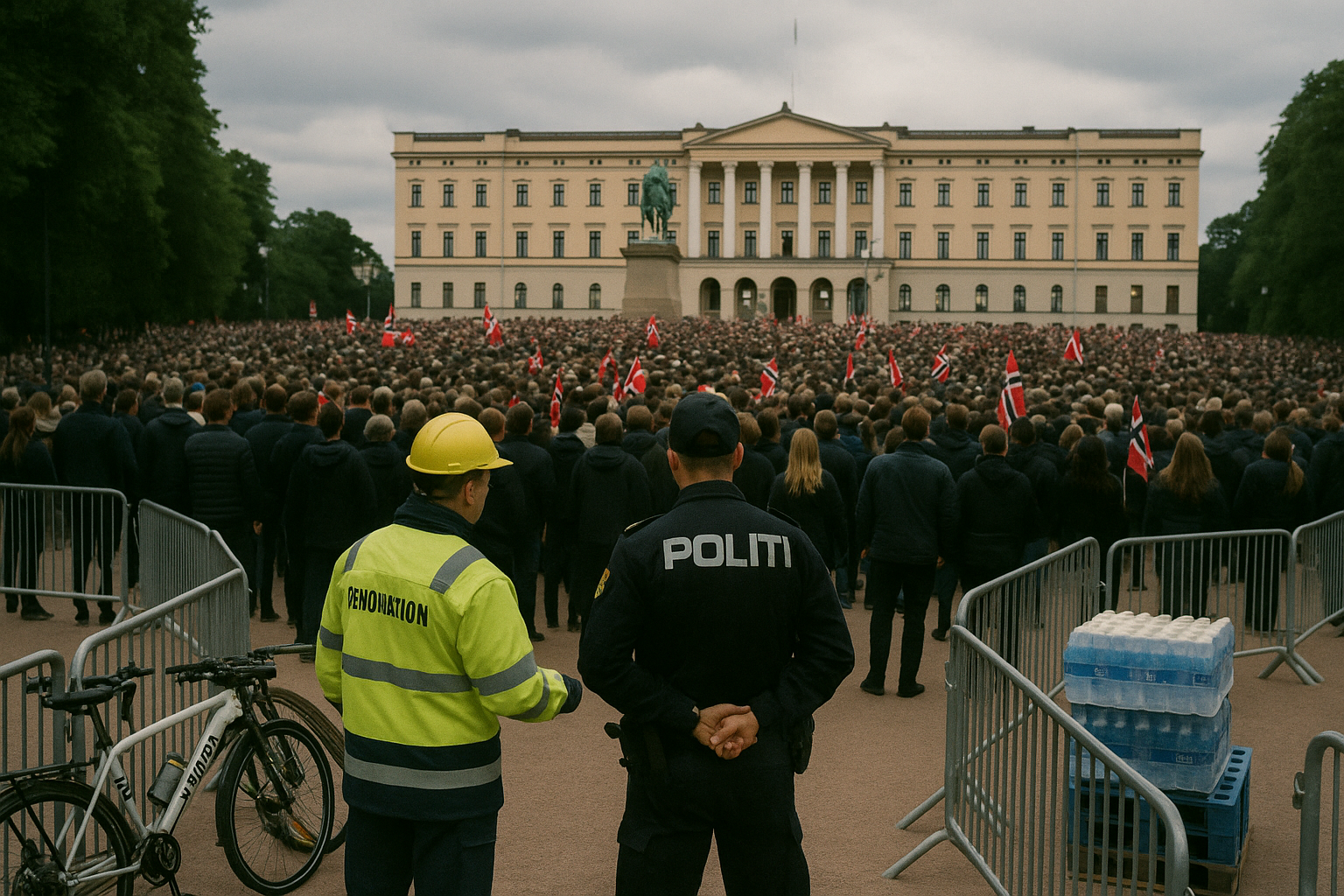
Oslo fills Slottsplassen for Norway team, 20,000 gather after defeat, police and city absorb another mass event
- Nettavisen reports that about 20,000 people assembled at Slottsplassen after Norway’s loss to England.
- The gathering shifted attention from the result to Oslo’s use of ceremonial public space for mass civic events.
- Large spontaneous crowds carry costs for policing, transport, sanitation and crowd management even when the atmosphere is celebratory.
About 20,000 people gathered at Slottsplassen, the square outside the Royal Palace in Oslo, to thank Norway’s women’s national team after the World Cup defeat to England. Nettavisen reports that the reception drew a crowd large enough to turn a farewell tribute into one of the capital’s biggest public gatherings outside its fixed annual rituals.
The football result was settled before the team arrived. What remained was the city itself: palace forecourt, tram lines, police presence, barriers, loudspeakers and thousands of people choosing to spend the evening in the same place. Slottsplassen is built for ceremony, protest and monarchy in equal measure, and Oslo used it again as a pressure valve for national feeling. A crowd of that size does not appear without consequences for public transport, cleaning crews, security planning and overtime budgets, even when the event is friendly and short-lived. The practical questions now are who formally organized the reception, whether the municipality or football federation carried the bill, and how much police and emergency services were required to keep the area open and moving.
That matters beyond one football tournament. Norwegian cities increasingly market public space as open, safe and available for collective celebration, but openness still has to be administered. Every successful gathering teaches officials something about access routes, crowd density, screening, staffing and how quickly a symbolic event becomes an operational one. The same square that hosts tourists and ceremonial guards can, within hours, become a venue requiring traffic control and incident readiness for a small town’s worth of people.
So far, the available reporting points to a festive reception rather than a disorder problem. If that holds, Oslo managed to absorb 20,000 people at the palace without the story ending in arrests, evacuations or visible crowd failure. On Slottsplassen, after a defeat, the capital still found room for 20,000 people to show up at once.
Källor: Nettavisen