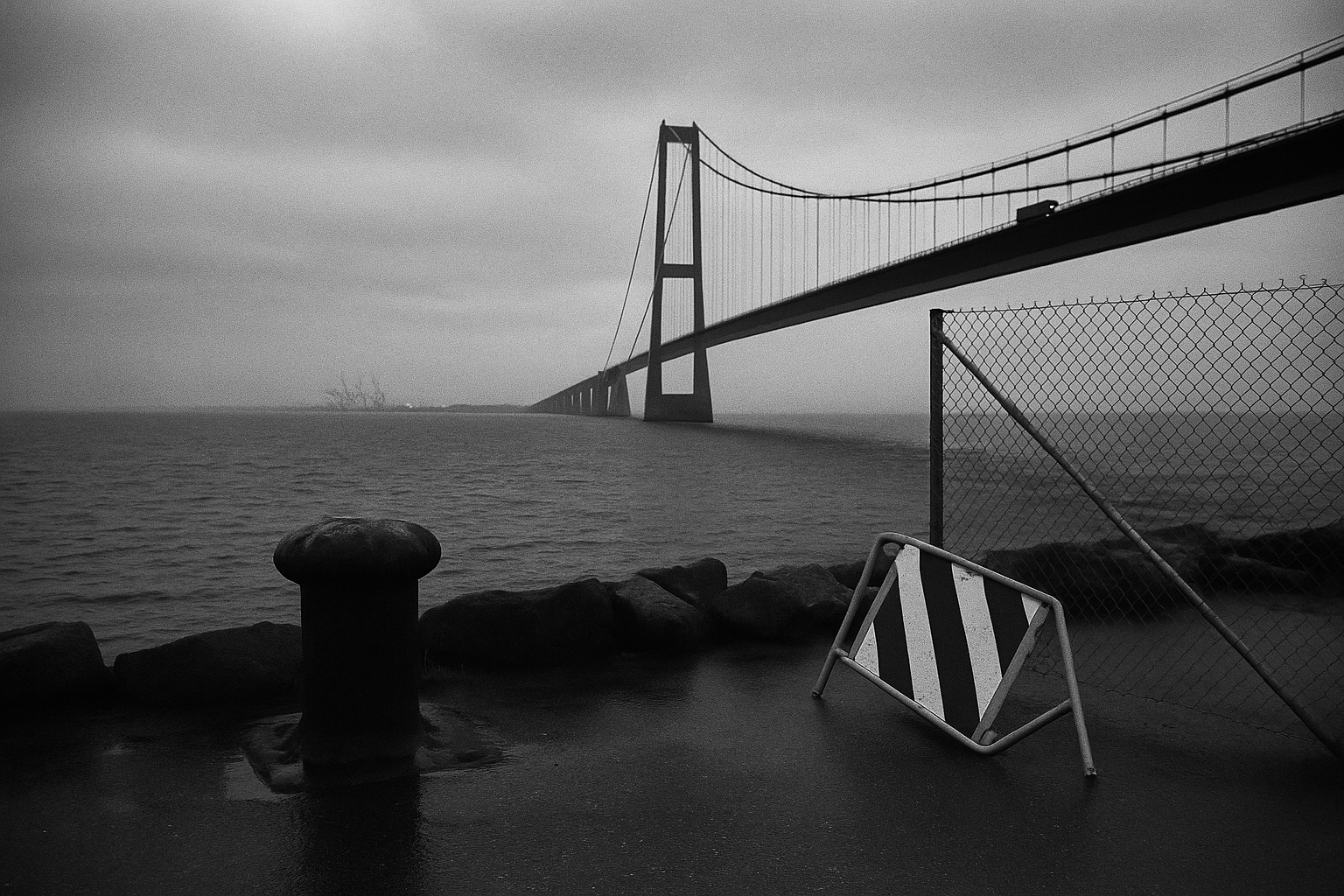
Russian threat shifts to Danish crossings, intelligence chiefs flag ports and bridges, resilience debate reaches Storebælt
- DR reports that Danish bridges and ports could be Russian targets in a future war.
- Storebælt and Lillebælt are both civilian transport links and military corridors between Danish regions and the continent.
- Much of Denmark’s protective work is classified, leaving the public to infer readiness from exercises, patrols and contingency planning.
- The debate now reaches beyond sabotage scenarios to whether Denmark has built enough national resilience without assuming outside help will arrive on time.
The Storebælt and Lillebælt crossings, used daily by freight, commuters and military traffic, are now being discussed as possible wartime targets. DR reports that Nordic intelligence chiefs and top officers assess that Russian planning in a new war could include attacks on Danish ports, bridges and other critical infrastructure.
That warning lands in a country built around chokepoints. The Great Belt Bridge links eastern and western Denmark; the Little Belt crossings tie Jutland to Funen; the ports move fuel, containers, ferries and military cargo. If one of those links is disabled, the effect is not confined to one municipality. Trucks reroute, rail traffic stalls, island supply chains tighten and military reinforcement across Denmark slows at the same moment the state would need movement the most.
What Denmark has done to harden those arteries is only partly visible. Publicly, authorities have expanded surveillance around sensitive sites, raised attention to undersea cables and maritime traffic, and stepped up military activity in the Danish straits after the sabotage of the Nord Stream pipelines shifted the threat picture in the Baltic Sea. Ports, bridges and energy installations have also become regular features in contingency planning and civil preparedness exercises. The rest sits behind classification: physical protection measures, repair capacity, redundancy plans, guard routines and the thresholds for military support are not described in detail for obvious reasons.
The gap between what is visible and what is secret leaves a narrower public question: how much redundancy Denmark actually has. A bridge can be guarded more heavily than before, but it still remains a bridge; a port can add patrols and barriers, but cargo still has to enter through a limited number of quays, channels and road links. Denmark’s geography gives it commercial advantages in peacetime and concentrates risk in a crisis. The same narrow passages that make the country a transit hub also make it legible to anyone drawing up target lists.
The warning also cuts into a larger defence assumption. Denmark has spent decades inside a NATO framework where reinforcement, maritime control and strategic depth were treated as allied tasks. That model looks thinner when the first hours of a conflict are measured in disrupted ferries, blocked rail lines and damaged bridge spans. National resilience is less glamorous than alliance communiqués, but a convoy cannot drive over a press release.
Protecting every bridge, port and maritime bottleneck all the time would be expensive and intrusive. Cameras, patrol boats, access controls, inspections and cyber monitoring all carry a price, and so does building spare capacity that may sit idle for years. Denmark’s map does not change, though. The Storebælt crossing is still one bridge-and-tunnel system carrying tens of thousands of vehicles a day.
Källor: DR Nyheder