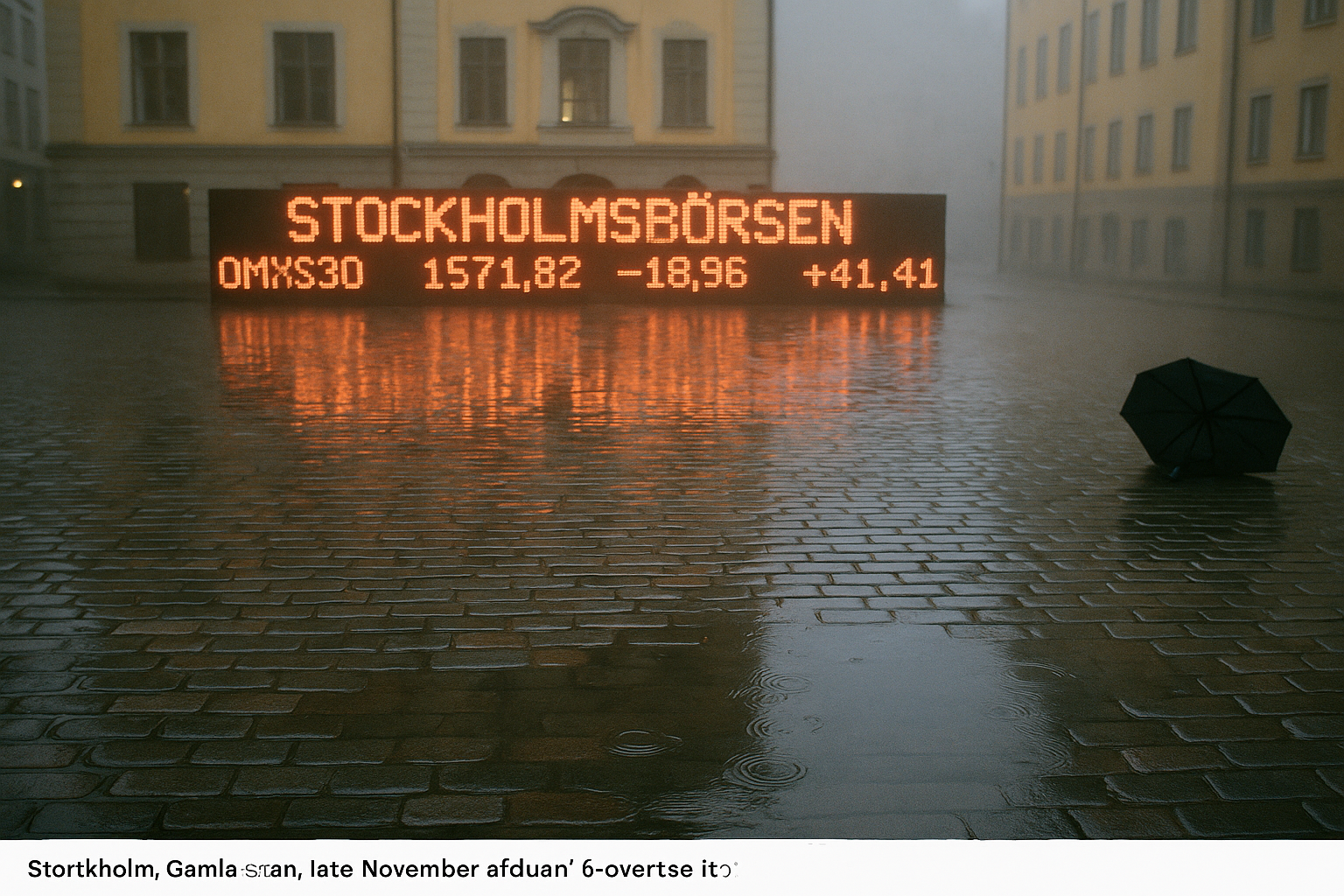
Stockholm Exchange Drops Five Percent as Iran Escalation Hits Export-Heavy Sweden Hardest
- OMX Stockholm fell roughly five percent in one week, driven by the escalating Iran conflict
- Sweden's export-heavy economy — industrials, energy, raw materials — makes its bourse more vulnerable than Nordic peers
- Danish, Norwegian, and Finnish exchanges saw smaller declines, partly due to different sectoral compositions
- Swedish pension savers carry concentrated exposure to the domestic equity market with limited state backstops
The OMX Stockholm index shed roughly five percent over the past week as the military escalation around Iran sent shockwaves through global markets, Svenska Dagbladet reports. The drop wiped tens of billions of kronor off Swedish equity valuations and hit directly at the retirement savings of millions of Swedes whose pension funds maintain heavy allocations to the domestic stock market.
Sweden's particular vulnerability stems from the composition of its bourse. The Stockholm exchange is dominated by export-oriented industrial conglomerates — Atlas Copco, Volvo, Sandvik, SKF — whose revenues depend on stable global trade flows and functioning supply chains. When a major conflict threatens shipping lanes in the Persian Gulf, oil prices spike and trade risk premiums rise, these companies take the first hit. Energy-intensive sectors and raw materials firms face a double squeeze: higher input costs and weaker demand forecasts simultaneously.
A comparison across the Nordic exchanges underlines how exposed Sweden is. Copenhagen's OMX C25, weighted heavily toward Novo Nordisk and the pharmaceutical sector, proved more resilient — healthcare demand doesn't collapse because of a Middle Eastern conflict. Oslo's benchmark actually benefited in part from rising oil prices, given Norway's petroleum-heavy index composition. Helsinki's exchange, smaller and more diversified between telecoms, forestry, and industrials, also posted a milder decline. Sweden's export dependence — exports account for roughly 45 percent of GDP, compared to about 37 percent for Finland and 55 percent for Denmark, though Denmark's exports are more defensively positioned — leaves Stockholm disproportionately sensitive to geopolitical shocks that disrupt global trade.
The question of who absorbs the losses is straightforward. Sweden's premium pension system (premiepension) channels workers' contributions into funds that are overwhelmingly invested in equities, with a strong home bias toward Swedish stocks. The AP funds — the national pension buffers — likewise hold substantial Swedish equity positions. Neither the Riksbank nor the Finansinspektionen (Financial Supervisory Authority) has announced any stabilising measures, nor would they be expected to: Sweden has no equivalent of a sovereign wealth fund that could step in to cushion equity market losses. The institutional architecture is designed so that market risk flows directly through to individual savers.
This contrasts with Norway, where the Government Pension Fund Global — the world's largest sovereign wealth fund at over 17 trillion kroner — is invested almost entirely outside Norway, deliberately insulating Norwegian pensions from domestic market volatility. Swedish pension savers enjoy no such buffer. When the Stockholm exchange drops five percent, their retirement accounts drop with it, and no state mechanism exists to smooth the blow.
The five percent weekly decline is steep but not catastrophic — markets recover from geopolitical shocks, usually within months. The structural issue is the concentration of risk. Swedish workers are compelled by law to invest a portion of their wages in a system that channels money heavily into a single, export-dependent equity market. When the next shock arrives — and the Iran conflict may only be beginning — the same savers will absorb the same losses, through the same pipeline, with the same absence of any cushion between them and the market.
Sources: Svenska Dagbladet