Stockholm rips out 60-year-old power lines, builds grid capacity equal to two nuclear reactors
- The grid expansion adds capacity equivalent to two nuclear reactors to the Stockholm region
- Sixty-year-old power lines are being torn out to make room for new infrastructure
- The project is one of the largest grid investments in the capital in decades, funded through grid fees passed to consumers
- Sweden shut down several nuclear reactors in recent years, tightening the very supply this expansion now scrambles to replace
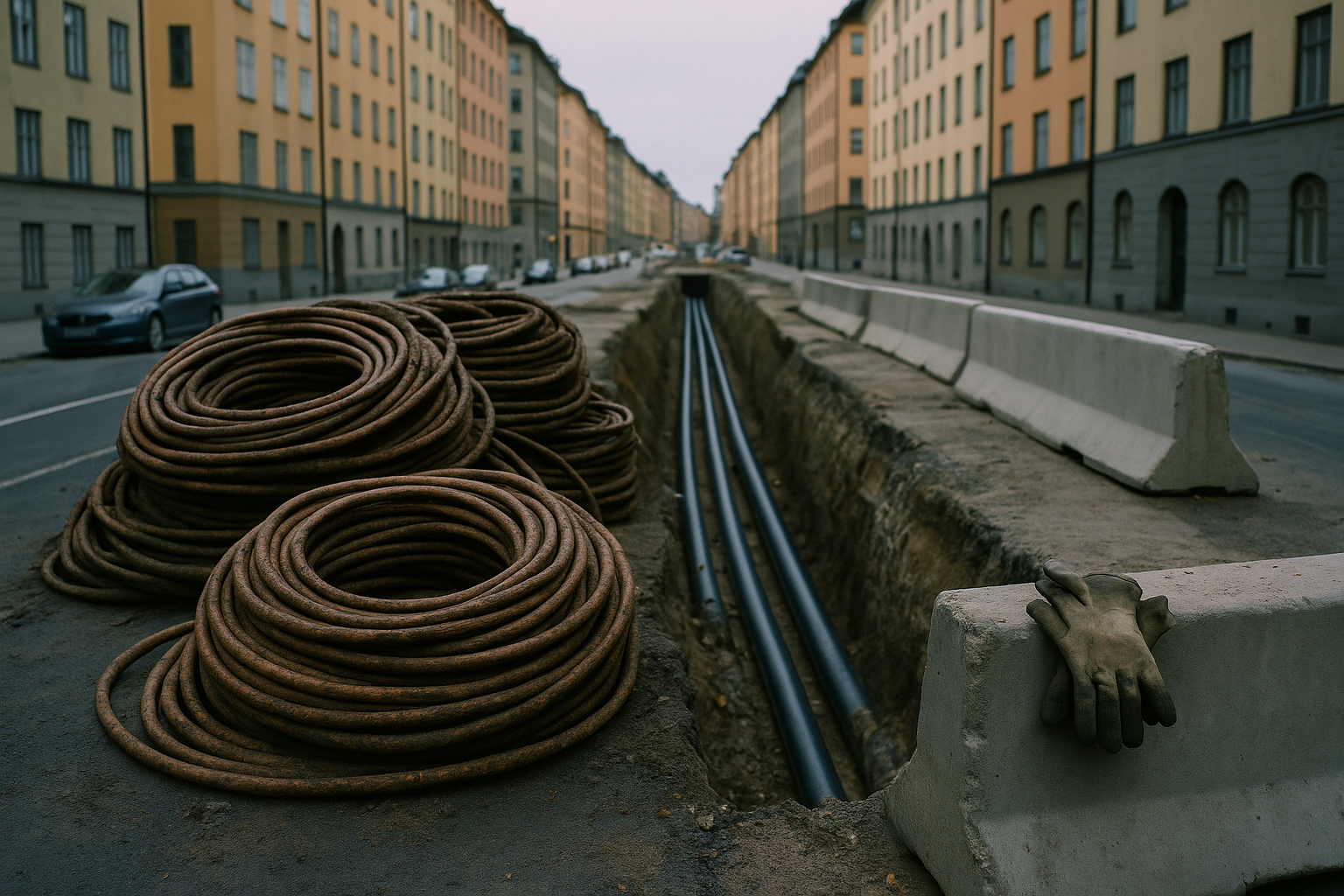
Crews in Stockholm are pulling down power lines that have hung since the early 1960s, clearing the way for one of the largest electricity grid expansions the capital region has seen in decades. SVT Nyheter reports that the project will add capacity equivalent to two nuclear reactors, with billions of kronor being poured into infrastructure designed to keep Stockholm's lights on as the region densifies, electrifies transport, and courts data centres.
The scale of the investment tells a story about what happens when a growing capital runs headlong into a grid built for a smaller, less electricity-dependent city. Stockholm's population has surged, new residential districts are rising, and the push to electrify everything from buses to heating systems has created demand the old network cannot meet. Grid operators have been warning for years that the bottleneck is not generation alone but transmission — the physical wires and substations that move power from where it is produced to where it is consumed. This project addresses that constraint directly.
What it does not address is why the constraint became so acute. Sweden closed four nuclear reactors between 2017 and 2020 — Oskarshamn 1 and 2, Ringhals 1 and 2 — removing roughly 2,700 megawatts of baseload capacity from the system. Those closures were driven partly by a punitive tax on nuclear thermal output, introduced by the Social Democrats and the Green Party, which made older reactors unprofitable. The tax was eventually scrapped, but by then the reactors were already being decommissioned. Stockholm now spends billions building grid capacity measured in nuclear-reactor equivalents while the country has spent the past decade dismantling actual nuclear reactors. The new capacity is transmission, not generation — it allows more power to flow into the region, but only if there is power to send. Southern Sweden, where Stockholm sits in pricing terms, has become a net importer of electricity from the hydro-rich north, and price differentials between the north and south have widened sharply.
The cost of the grid expansion will be borne primarily through nätavgifter — grid fees charged to households and businesses on their electricity bills. This is the standard Swedish model: grid companies, regulated monopolies, recover investment costs from end users. There is no direct state subsidy. For Stockholm residents already facing elevated electricity prices compared to northern Sweden, the fees represent another layer of cost for infrastructure that a more rational energy policy might have made less urgent.
The project's timeline stretches years into the future, with the full capacity addition not expected until the late 2020s at the earliest. In the meantime, Stockholm's grid constraints continue to delay new housing connections, slow data centre expansion, and complicate the city's climate targets. Several large data centre projects have looked elsewhere in Sweden — or elsewhere in the Nordics entirely — because Stockholm simply could not guarantee the power.
Sweden is now building transmission capacity equivalent to two nuclear reactors to serve a region that lost access to two actual nuclear reactors less than a decade ago. The old power lines coming down in Stockholm were installed when Sweden was building its nuclear fleet. The new ones go up as the country tries to figure out what replaces it.
Sources: SVT Nyheter