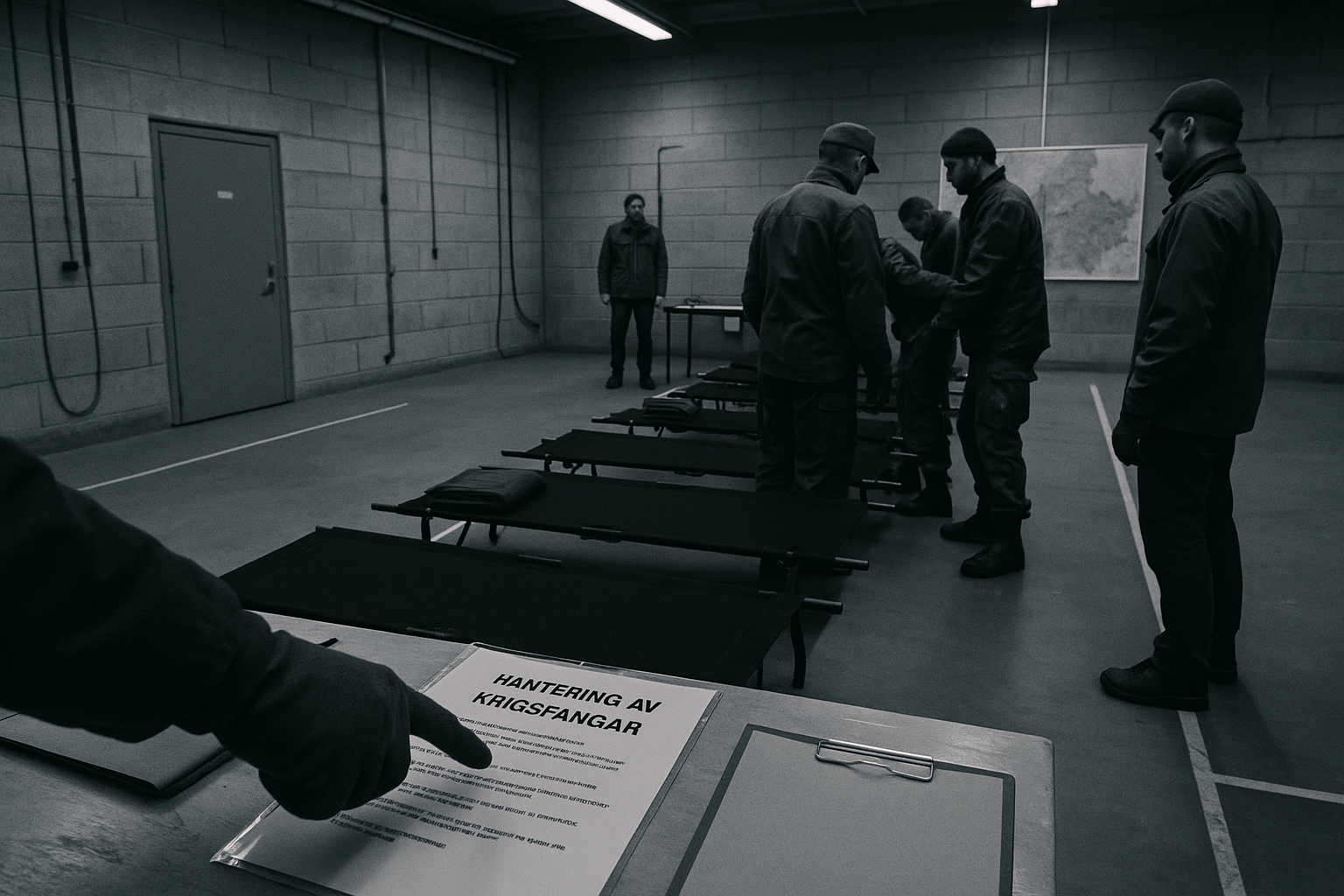
Sweden runs Cold War-scale POW drill, Ukraine supplies battlefield lessons, defence planning drops peacetime script
- Swedish military police conducted the largest POW-handling exercise in decades.
- Ukrainian armed forces provided direct input based on wartime experience.
- The exercise points to gaps in Sweden’s own preparedness for large-scale war.
- Military procedures are being revised around detention, transport and documentation.
Sweden’s armed forces have carried out their largest exercise in handling prisoners of war since the Cold War, and they did it with Ukrainian officers on site. Sveriges Radio Ekot reports that experts from the Ukrainian armed forces took part as Swedish military police trained for wartime capture, detention and processing of prisoners on a scale the country has not rehearsed for decades.
The exercise is more than a gesture of support for Kyiv. Ukraine is one of the few European militaries with current, large-scale experience of managing prisoners in a high-intensity war, where detention is not a legal seminar but a chain of transport, searches, registration, guarding, medical checks and interrogation under pressure. Håkan Isaksson, commander of the First Military Police Battalion, told Ekot that the Ukrainian contribution had been invaluable. That phrasing carries its own message: Sweden is relearning a wartime function it once treated as routine and later allowed to atrophy.
For years, Swedish defence planning was built around smaller overseas missions, domestic support tasks and a security environment where mass capture of enemy personnel was remote. A prisoner-of-war system under those conditions can remain mostly a binder on a shelf. A war between states makes it an immediate logistics problem. Units need trained guards, secure facilities, reporting chains, legal procedures under the Geneva Conventions, and the ability to move detainees without stripping combat troops from the front. The larger the exercise, the clearer the underlying calculation: this is no longer being planned as an edge case.
Ukraine’s role also shows where current expertise sits. Sweden has expanded defence spending, reintroduced conscription and entered NATO, but money and formal alliances do not automatically produce recent operational knowledge. Ukraine does. Its officers have had to solve the problems Sweden is now simulating: what happens when prisoners arrive in numbers, when documentation must be exact, when abuse by tired or angry troops becomes a command problem, and when every failure can carry legal and strategic costs. A military that has not faced those pressures in generations will either learn from others or learn late.
The exercise fits a wider shift in Swedish defence doctrine away from the low-volume assumptions of the post-Cold War years. Preparedness now means planning for attrition, territorial defence and long campaigns on Swedish soil or in its immediate region. Prisoner handling sits far from the glamour end of rearmament, but it is one of the clearest markers of whether an army expects real war rather than a sequence of controlled deployments. The Swedish military police did not bring in Ukrainian experts to decorate the exercise. They brought them in because Ukraine has run the system under fire.
That leaves a plain fact. Sweden is rebuilding a wartime capability last exercised at this scale during the Cold War, and the instructors with the freshest experience came from a country already doing it for real.
Källor: Sveriges Radio Ekot