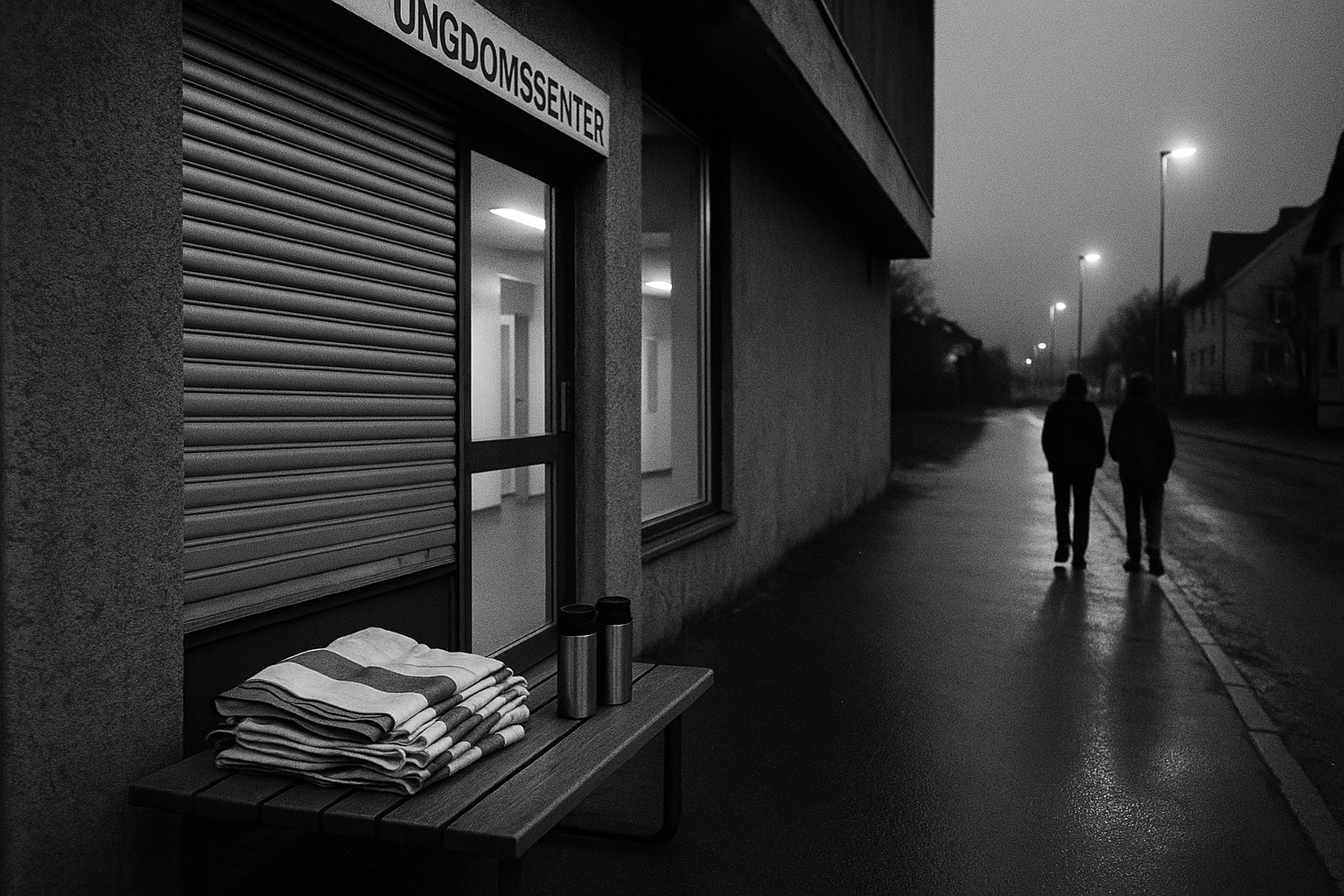
Tromsø shuts youth outreach for summer, police warn of rising violence, cheapest prevention goes dark
- Tromsø’s Utekontakten youth outreach service and Natteravnene summer patrols are closing during the holiday period.
- Police in Tromsø say youth violence is increasing and warn that criminal networks are trying to recruit minors.
- The cut removes low-threshold adult presence from streets and meeting places at the point in the year when school is closed.
- The immediate saving falls on the municipal budget; the follow-on burden shifts to parents, police and later more expensive interventions.
Tromsø is shutting its Utekontakten youth outreach service and the volunteer Natteravnene night patrols for the summer holiday, a budget decision that removes adult street presence just as schools close and teenagers spend more time outside home supervision. NRK reports that the municipality cites tight finances, while police in Tromsø are warning of increased youth violence and a growing risk that minors are drawn into criminal networks.
Utekontakten is one of the municipality’s lowest-threshold services: adults who meet young people where they already are, without appointments, referrals or formal case handling. Natteravnene, a volunteer scheme known across Norway, fills a similar gap with visible adults in city streets and public spaces during evenings. When both disappear at the same time, the first response no longer comes from outreach workers who know local youths by name but from parents asked to patrol more, and from police called when something has already happened.
That sequence matters because the costs rise at each step. A conversation in a park, a lift home, or an adult presence outside a shopping centre is cheap. Police patrols, emergency responses, child welfare interventions and court cases are not. NRK quotes police saying the concern is not abstract: they describe more youth violence and the possibility that criminal environments use the summer break, when routines are looser and supervision thinner, to recruit.
The timing is awkward in a northern city where summer brings long evenings, crowded public spaces and school-free weeks. Outreach work is built for exactly that window. Closing it for holidays means the municipality saves money by pausing the least formal part of its prevention chain, while the remaining institutions are the ones that enter later, with more paperwork, more coercion and higher cost per case.
NRK’s reporting also points to a familiar municipal trade-off. Preventive services rarely produce a dramatic daily metric; what they avert does not appear in a budget line. Their absence is measured elsewhere: in police callouts, in parents being told to step in, and in the number of teenagers first meeting the state through enforcement rather than through a known adult on the street. In Tromsø, that trade-off is being made in the open, during the school holiday, with the police already asking for more adults in circulation.
The city saves money this summer by turning off the service designed to notice trouble before it becomes a case number. The empty shift is on the street, after dark, during the weeks when school doors are locked.
Källor: NRK