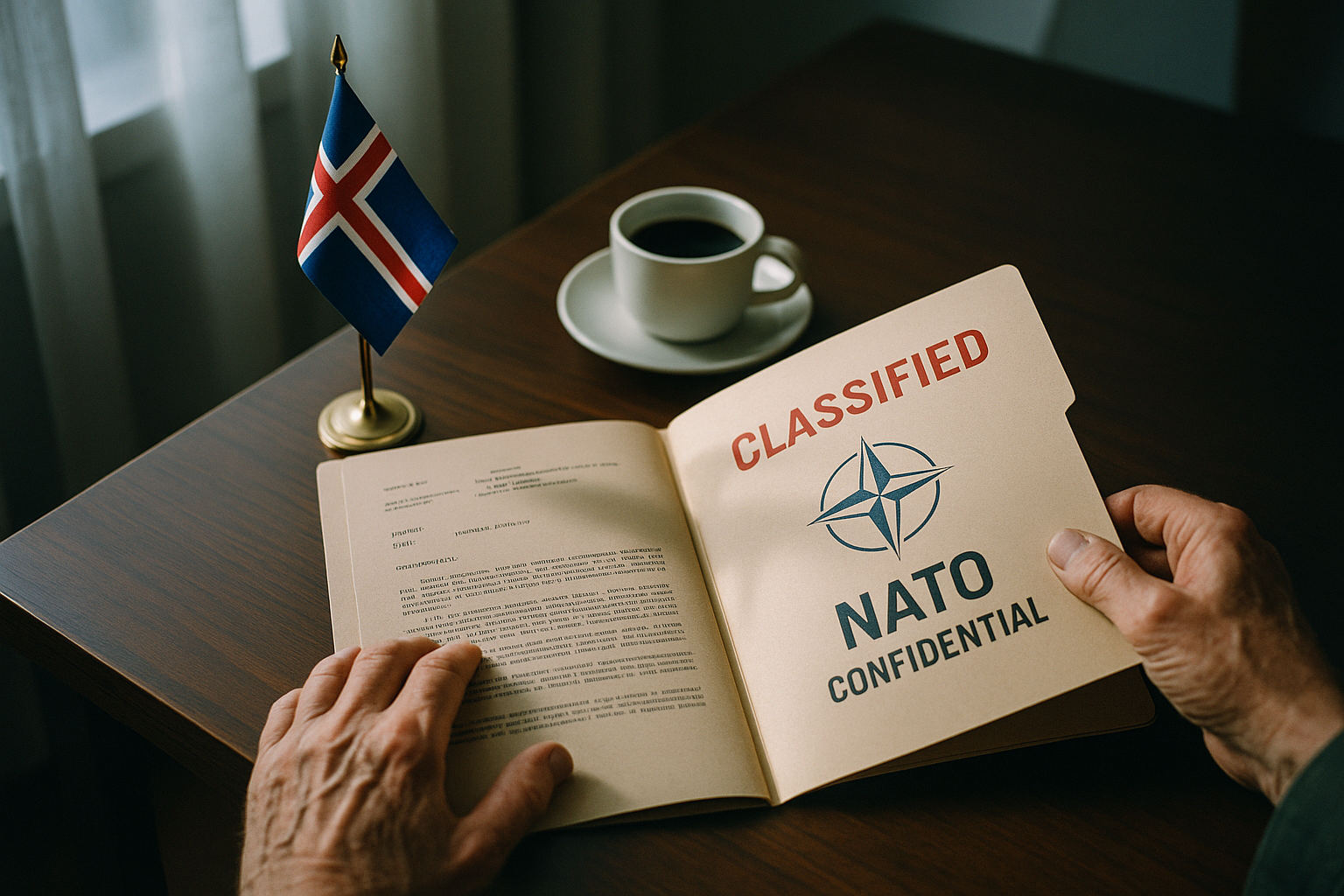
Washington tells Iceland: no exemptions on NATO spending, even without an army
- US officials explicitly told FM Þorgerður Katrín Gunnarsdóttir that Iceland is not exempt from European burden-sharing demands
- Iceland is the only NATO member with no standing army, relying on its strategic North Atlantic position and the Keflavík base as its contribution
- The demand raises practical questions about what increased Icelandic defence spending would even look like
- The pressure strengthens the case for Nordic defence cooperation independent of American strategic priorities
Iceland's Foreign Minister Þorgerður Katrín Gunnarsdóttir returned from meetings in Washington with a message that leaves little room for interpretation: American officials told her directly that Iceland will not be exempted from demands on European NATO members to raise their defence contributions. Morgunblaðið reports that the minister described the American position as unambiguous.
The statement carries particular weight because Iceland has occupied a singular position in the alliance since NATO's founding in 1949. It is the only member state with no standing military — no army, no navy, no air force. Iceland's contribution has instead been geographical: the island sits astride the GIUK gap, the stretch of North Atlantic between Greenland, Iceland, and the United Kingdom through which Russian submarines must pass to reach open ocean. The Keflavík air base, operated by the US until 2006 and now partially reactivated, has been Iceland's principal offering to collective defence. Washington, it appears, no longer considers location sufficient payment.
What increased Icelandic contributions would look like in practice is far from obvious. Iceland's entire population — roughly 380,000 — is smaller than most mid-sized European cities. It has no defence ministry in the traditional sense; foreign affairs handles security matters. The country spends a fraction of one percent of GDP on defence-related activities, mostly coast guard operations and a small crisis response unit. Reaching anything close to NATO's two percent target — itself now considered a floor rather than a ceiling — would require Iceland to either build military capabilities from scratch, purchase equipment it has no personnel to operate, or funnel money into allied programmes in exchange for continued protection. None of these options are straightforward, and all of them cost real money in a country where public finances are already under pressure from inflation and housing costs.
The broader question is who benefits from this arrangement. Washington's burden-sharing demands are framed as fairness — every ally should pay its share. But increased European spending routed through NATO structures flows overwhelmingly toward American defence contractors and reinforces American command over European security architecture. For Iceland, a country with no military tradition and no realistic prospect of independent defence, the choice is between paying more for American protection or investing in something closer to home.
This is where the Nordic dimension matters. Finland fields one of Europe's largest artillery forces. Norway operates advanced frigates and F-35s. Sweden manufactures its own fighter jets, submarines, and missile systems. Denmark maintains expeditionary forces tested in combat. Iceland contributes the most strategically valuable piece of real estate in the North Atlantic. A Nordic defence framework that pooled these assets — Finnish mass, Norwegian naval power, Swedish industry, Danish professionalism, and Icelandic geography — would constitute a serious military force without requiring Reykjavík to conjure an army out of the North Atlantic fog.
Instead, Iceland is being told to write larger cheques to an alliance whose strategic priorities are set in Washington. The Keflavík base protects American submarine detection networks and American power projection into the Arctic. Iceland has been paying with its geography for seventy-five years. The Americans have now decided that geography, like goodwill, doesn't show up on a balance sheet.
Sources: Morgunblaðið